Professor of Mathematics
Paata Ivanisvili
Department of Mathematics, University of California, Irvine

← Possible new impact sites on Mars
Candidate 18: North-west flank of Arsia Mons
Strong · roughly 85%
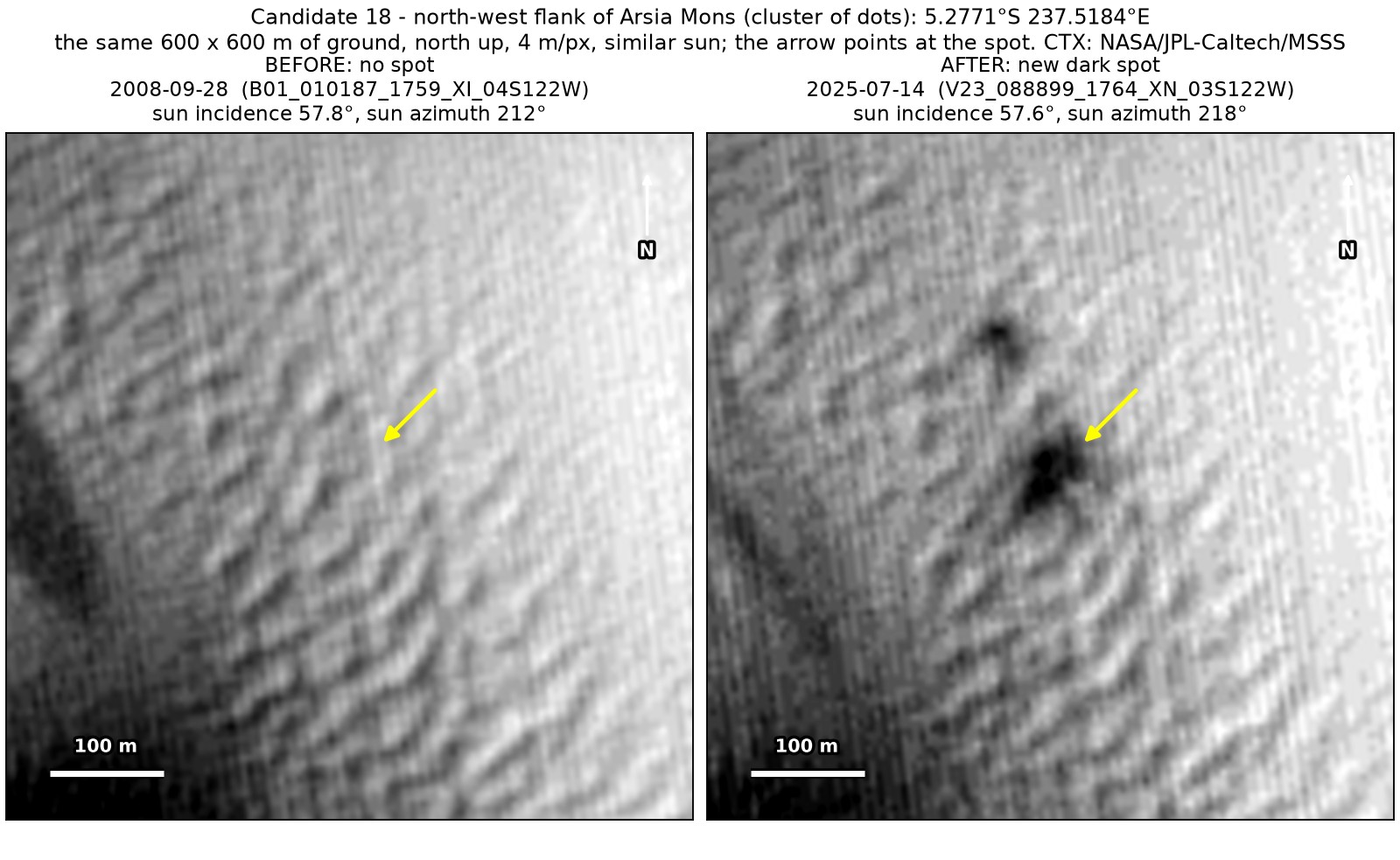
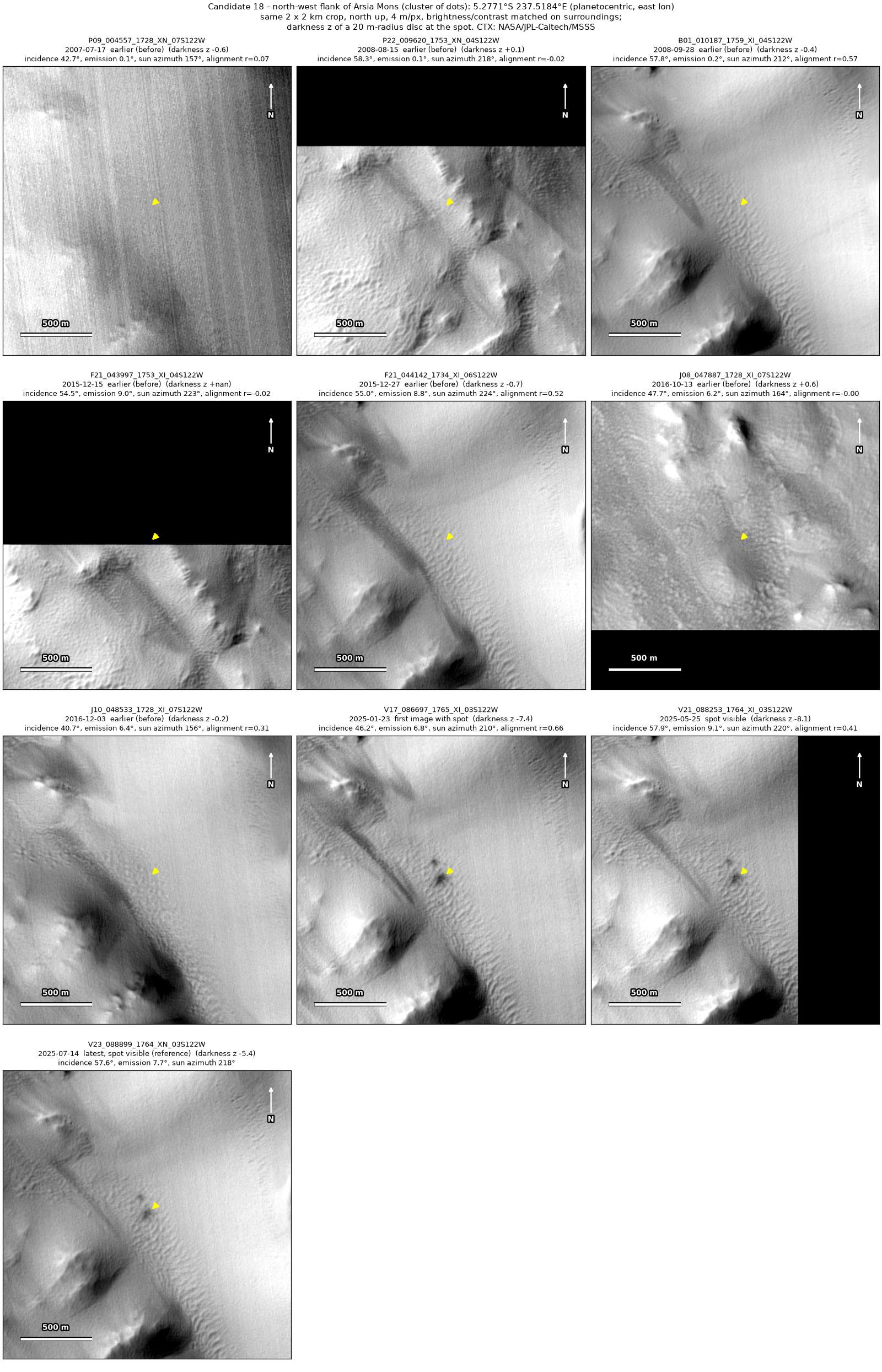
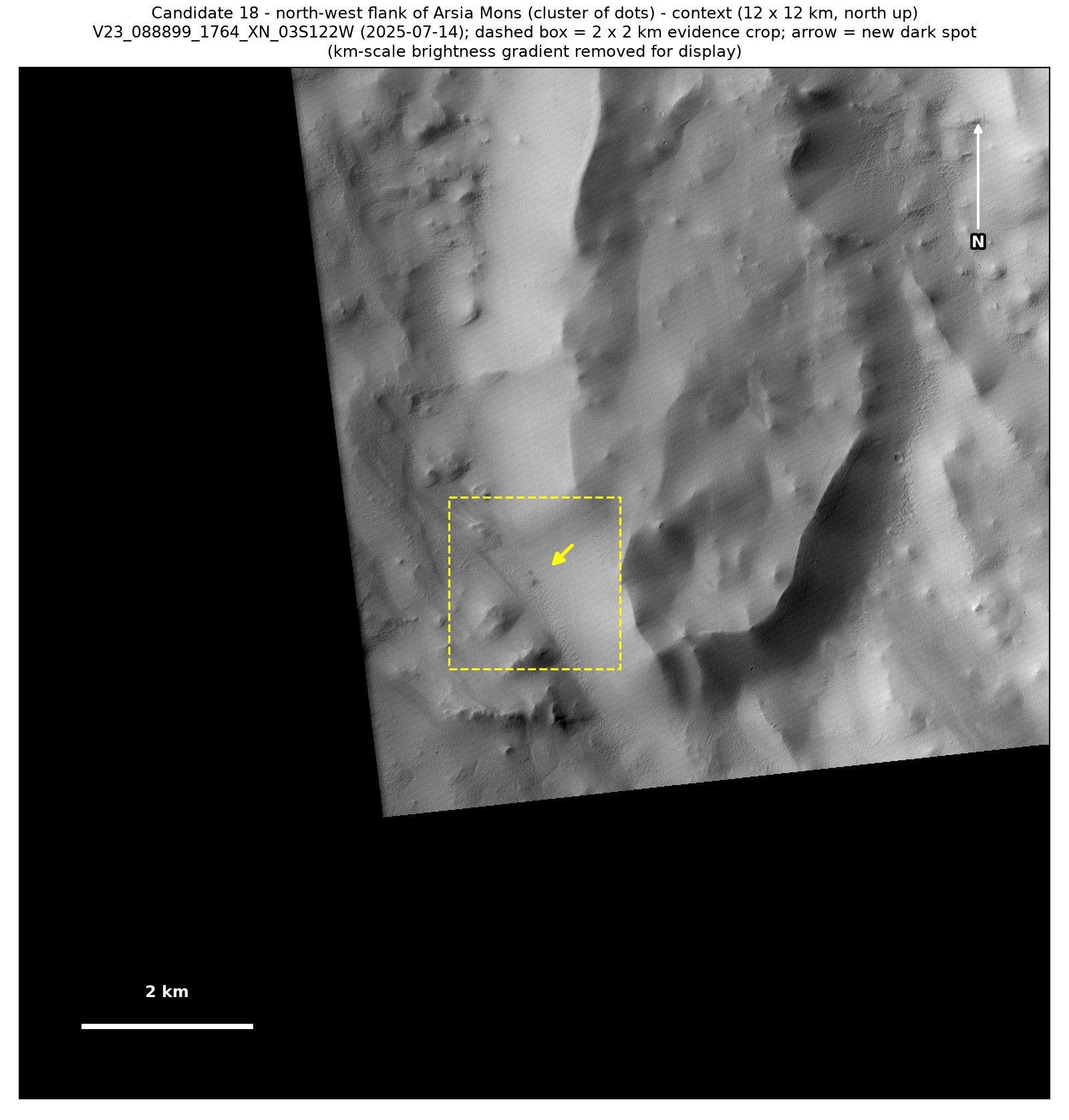
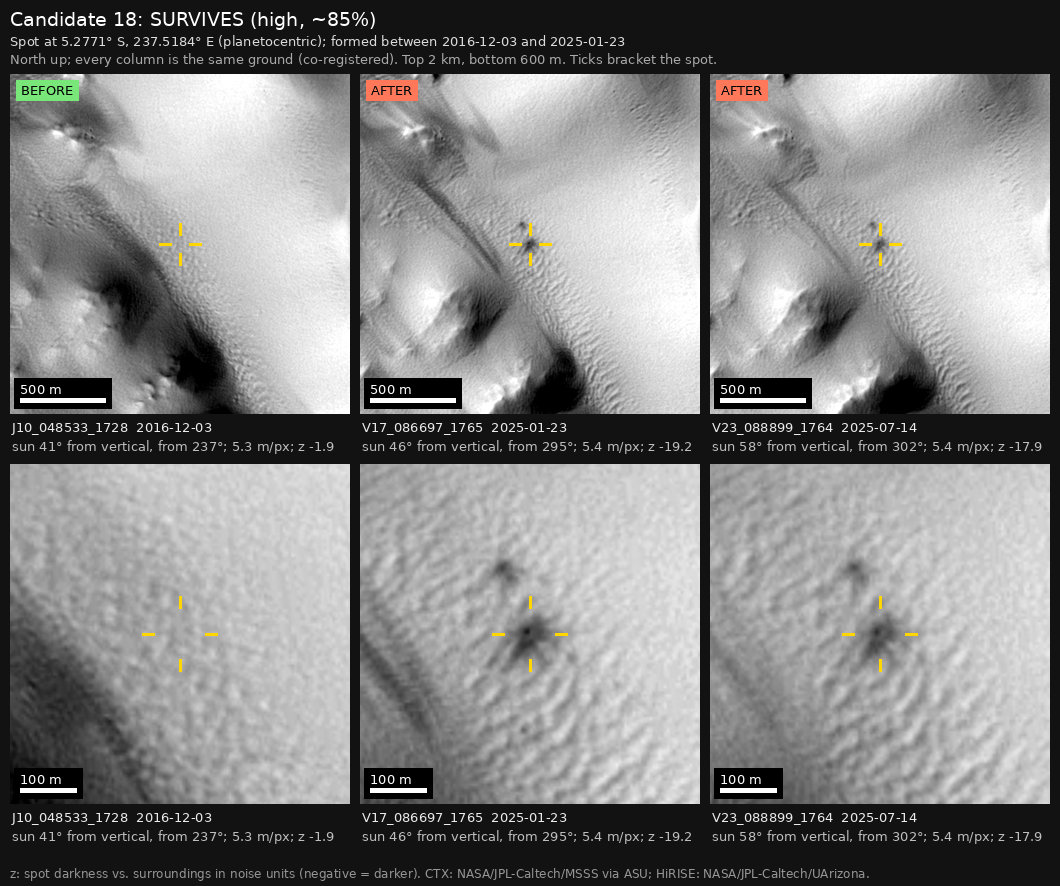
What changed. Three or four dark dots, each 15 to 30 m across and spread over about 150 m, appeared on the north-west flank of the volcano Arsia Mons between December 2016 and January 2025. They keep the same pattern in two later images, from May and July 2025.
Why it may be a new impact. Seven earlier images, from 2008 to 2016, show no dots there, and each of them would have shown them. A tight cluster of small dark spots is the classic mark of a meteoroid that broke up in the air before hitting the ground, and dark patches made by wind are not clusters of separate dots.
- Location
- 5.277° S, 237.518° E (122.482° W)
- Absent
- seven images from 15 August 2008 to 3 December 2016
- Present
- 23 January 2025, 25 May 2025 and 14 July 2025
- Size
- Three or four dark dots, each 15 to 30 m across, spread over about 150 m
- Confidence
- Strong candidate; roughly 85% that it is a new impact.
- Nearby
- Candidate 24, 75 km to the north-north-west, first shows in the same image of 23 January 2025. They are separate impacts: the craters of one broken-up meteoroid lie at most a few kilometres apart.
- Caveat
- It has been followed for only six months, so a short-lived dark patch made by wind is not excluded, although such patches are not clusters of separate dots. It lies outside every footprint of the high-resolution HiRISE camera. Like every candidate here, it is unconfirmed: see the caveat.