Professor of Mathematics
Paata Ivanisvili
Department of Mathematics, University of California, Irvine

← Possible new impact sites on Mars
Candidate 5: Cerberus plains, Elysium Planitia
Strong · roughly 70%
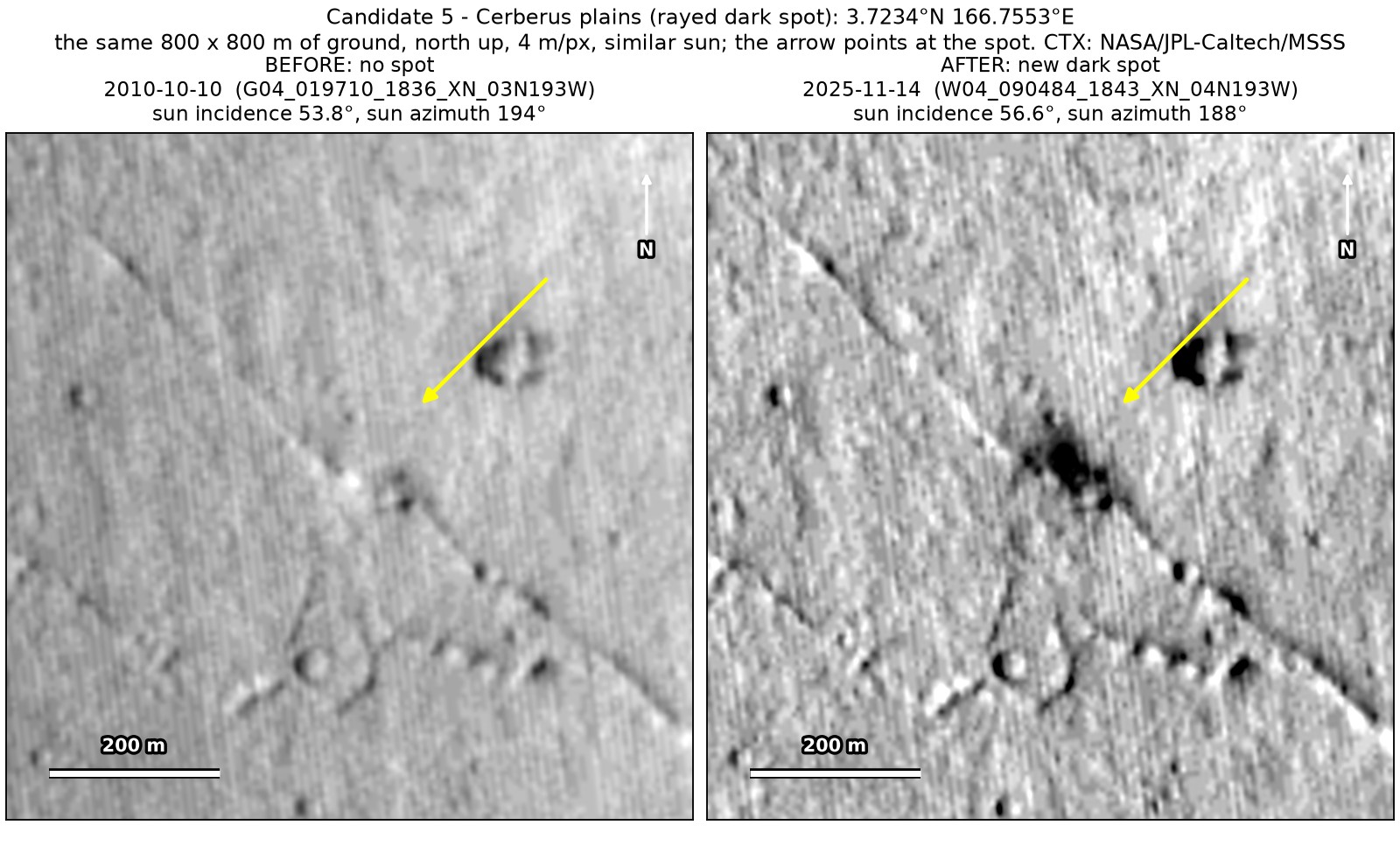
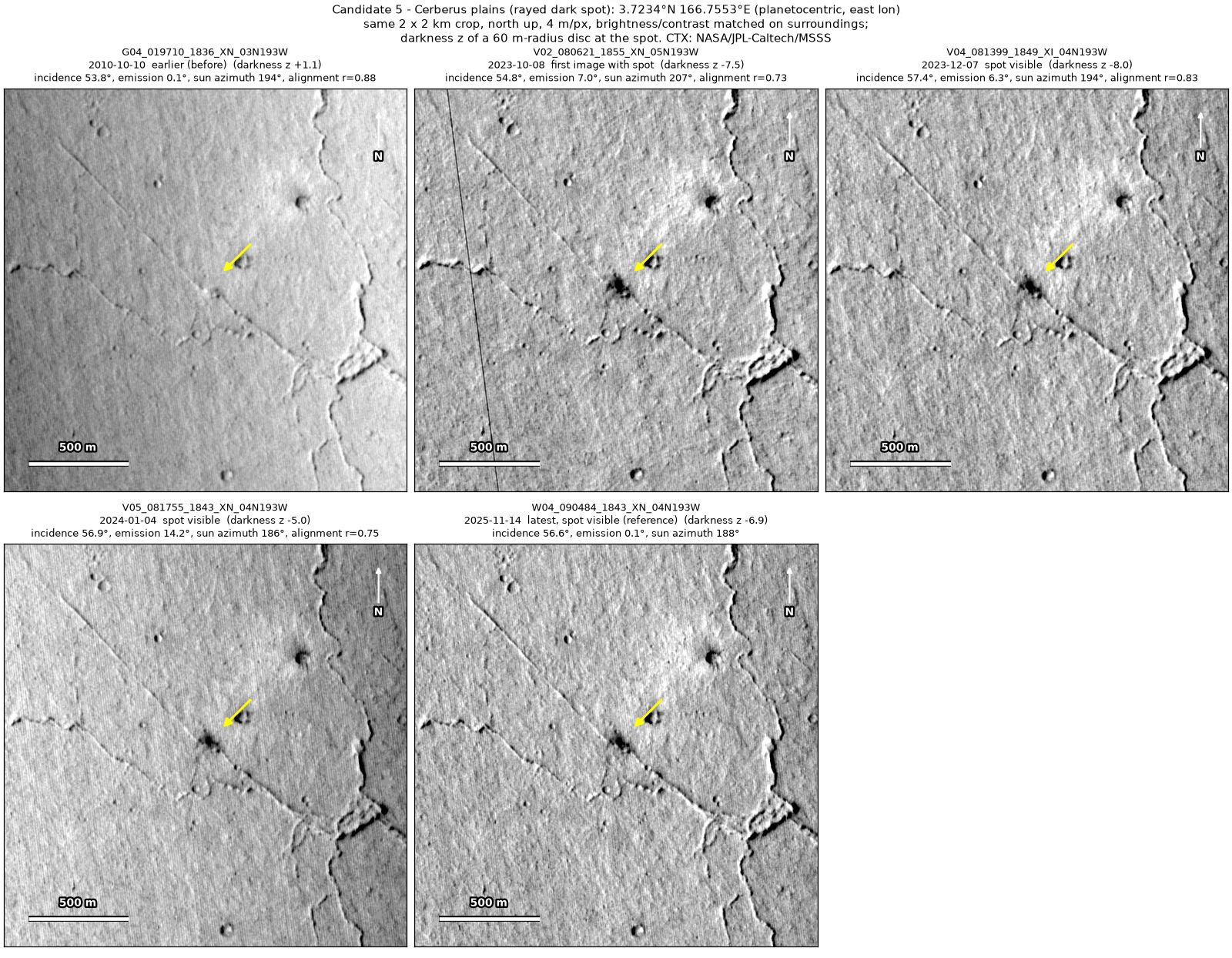
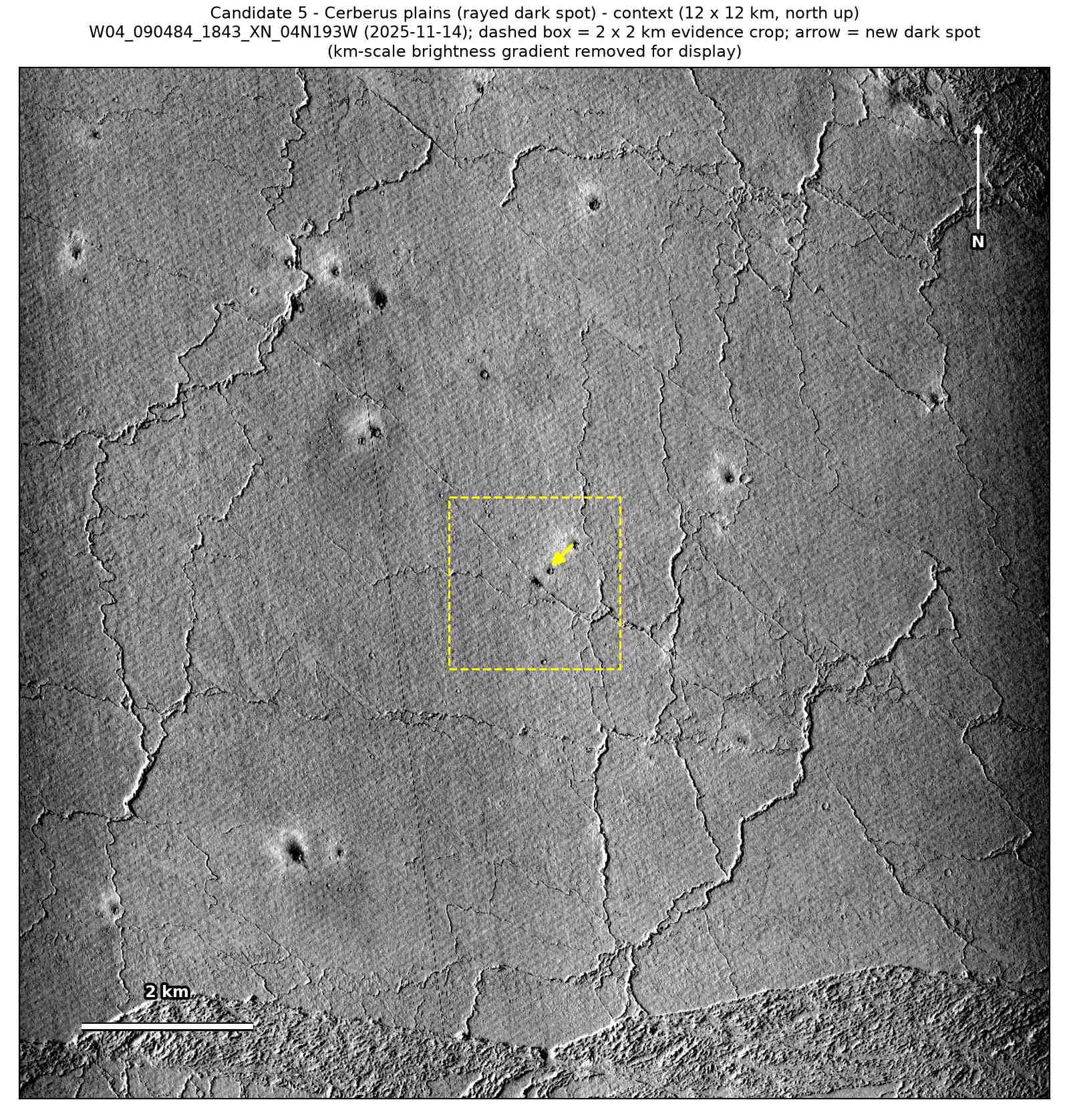
What changed. A dark spot 100 to 150 m across, with dark rays fanning out from a cluster of dark blobs, sits on the flat lava plains of Cerberus. It is identical in four images taken over two years, and absent in 2010 under the same lighting.
Why it may be a new impact. A rayed pattern around several dark centres is how a small meteoroid that broke apart just before impact typically looks from orbit.
- Location
- 3.723° N, 166.755° E
- Absent
- 10 October 2010
- Present
- four images from 8 October 2023 to 14 November 2025
- Size
- Dark spot 100 to 150 m across, with dark rays
- Confidence
- Strong candidate; roughly 70% that it is a new impact.
- Caveat
- It lies outside every footprint of the high-resolution HiRISE camera. It lies in the area of a catalogue of new impacts near the InSight lander (Bickel et al. 2025) that could not be downloaded, so it can only be inferred that the catalogue does not list it. Like every candidate here, it is unconfirmed: see the caveat.