Professor of Mathematics
Paata Ivanisvili
Department of Mathematics, University of California, Irvine

← Possible new impact sites on Mars
Candidate 6: Twin dark spot on the plains of Elysium Planitia
Strong · roughly 75%
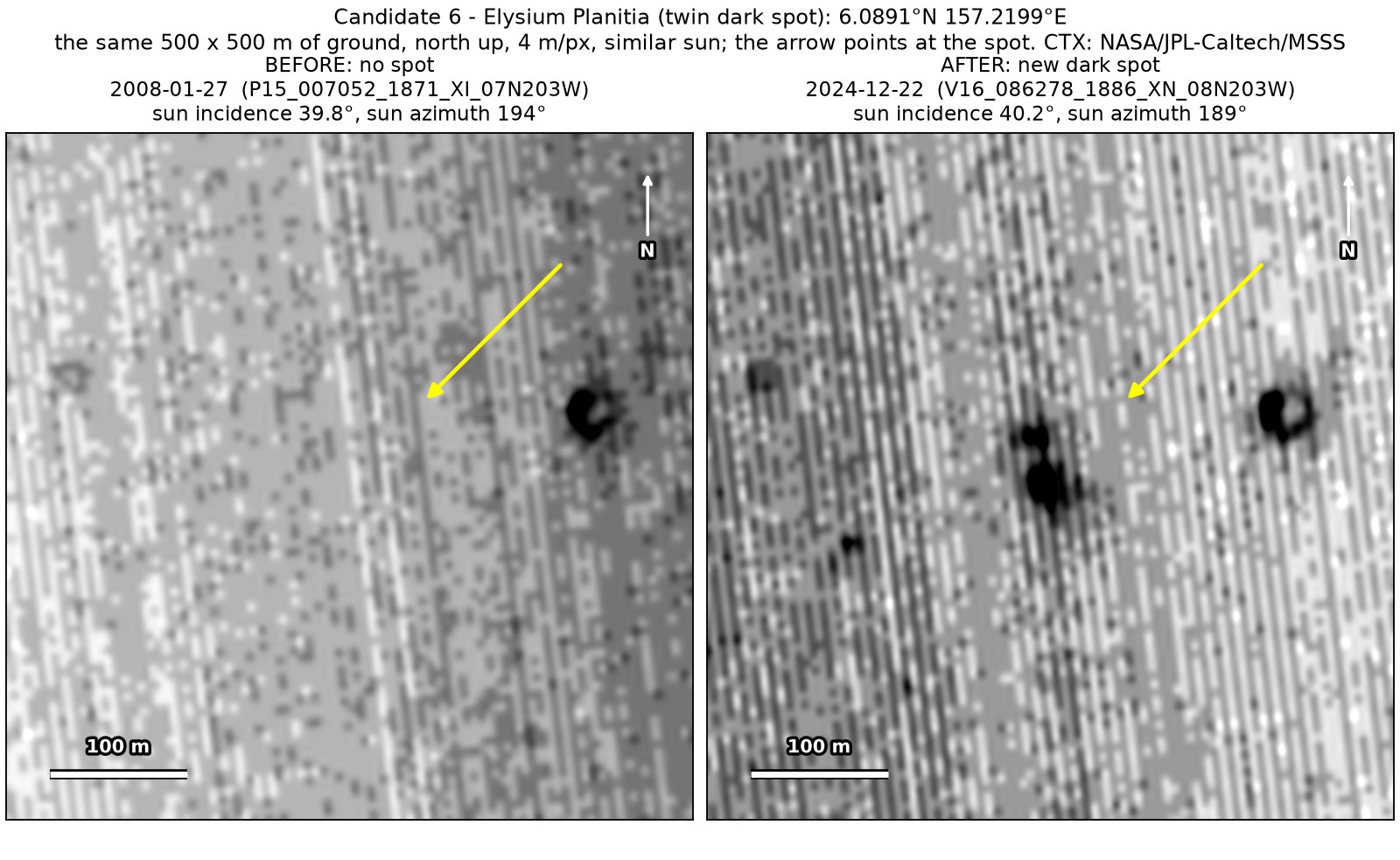
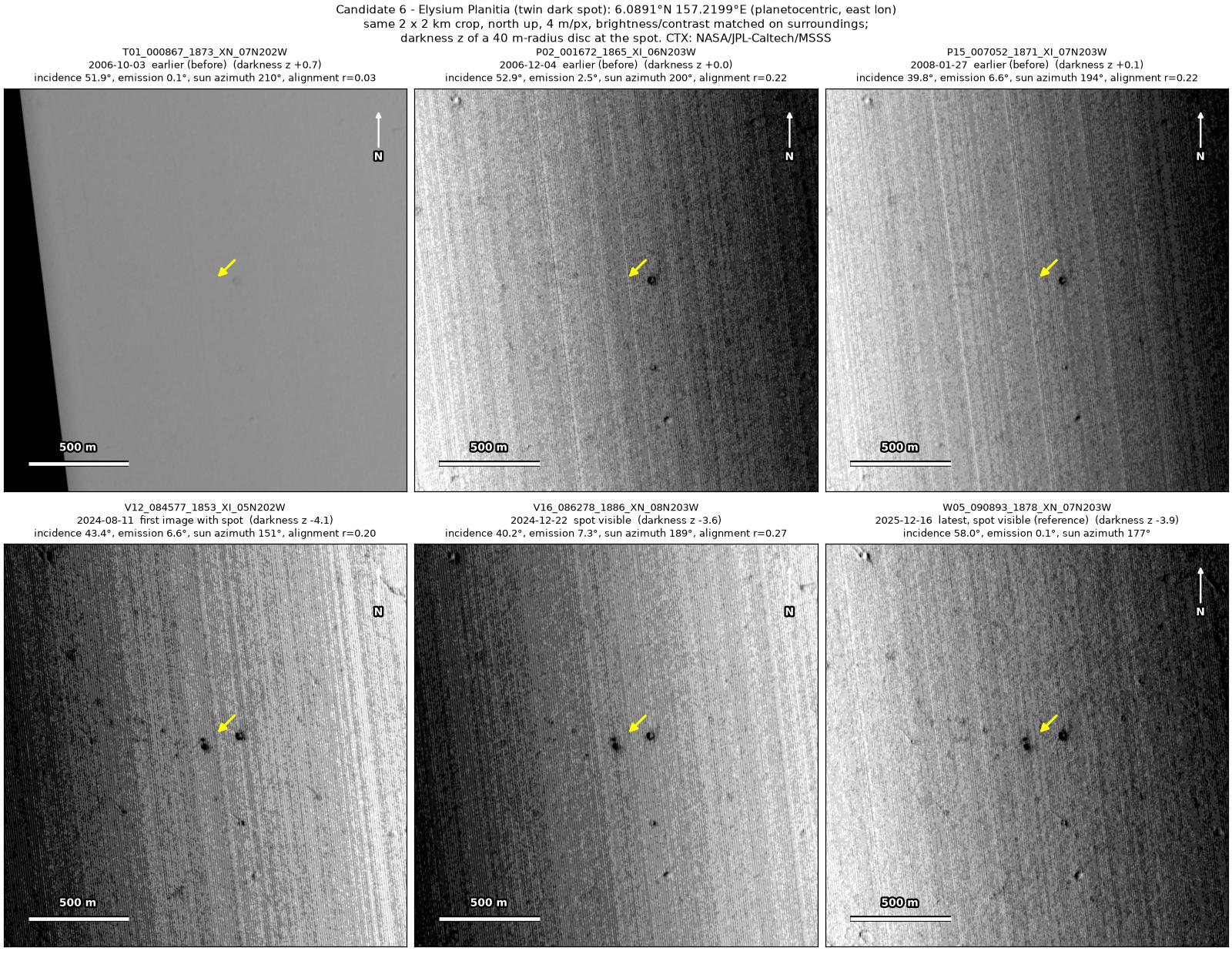
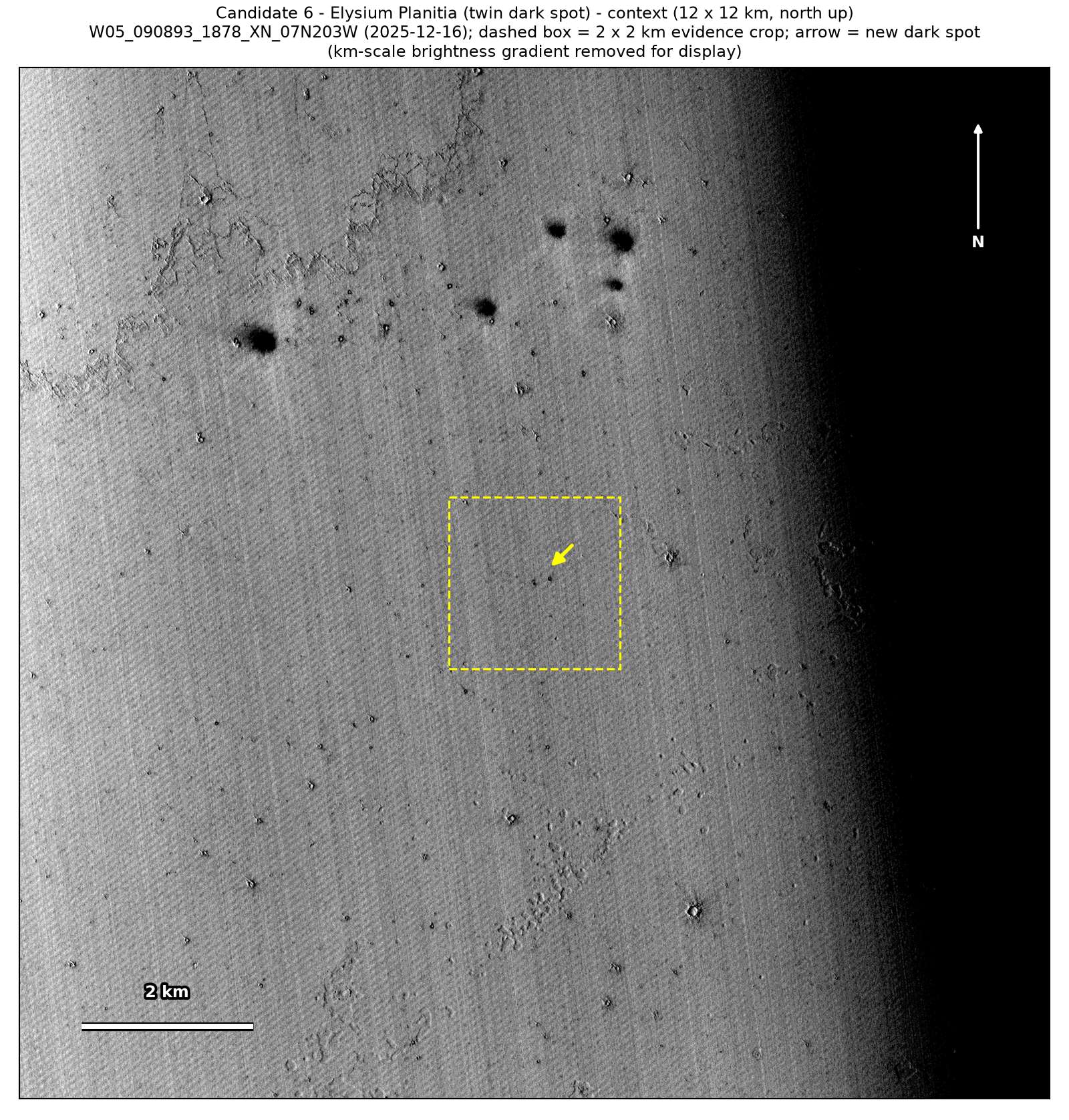
What changed. Two small dark spots, each about 20 m across and 35 m apart, appeared together on smooth plains between 2008 and 2024. An older dark spot nearby shows clearly in the earliest images, so those images would have caught the pair.
Why it may be a new impact. Two spots appearing at once is what happens when a meteoroid breaks in two in the thin Martian air.
- Location
- 6.089° N, 157.220° E
- Absent
- 3 October 2006, 4 December 2006 and 27 January 2008
- Present
- 11 August 2024, 22 December 2024 and 16 December 2025
- Size
- Two dark spots, each about 20 m across, 35 m apart
- Confidence
- Strong candidate; roughly 75% that it is a new impact.
- Caveat
- It lies outside every footprint of the high-resolution HiRISE camera. It lies in the area of a catalogue of new impacts near the InSight lander (Bickel et al. 2025) that could not be downloaded, so it can only be inferred that the catalogue does not list it. Like every candidate here, it is unconfirmed: see the caveat.