Professor of Mathematics

Paata Ivanisvili

pivanisv@uci.edu · x.com/PI010101

Department of Mathematics, University of California, Irvine

Paata Ivanisvili

← Possible new impact sites on Mars

Candidate 4: Arabia Terra, north-west of Pasteur crater

Strong · roughly 80%
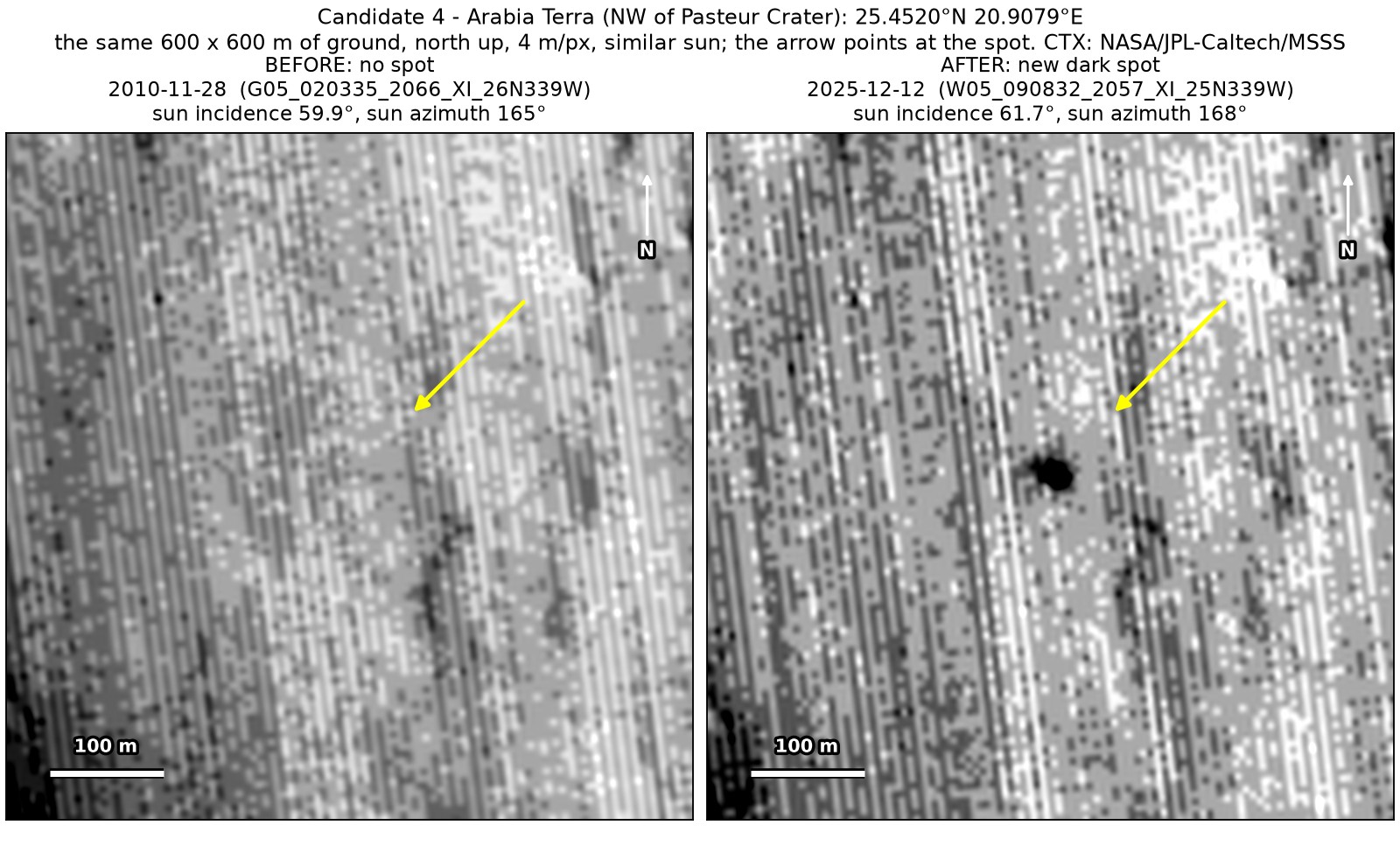
Two CTX close-ups of the same 600 by 600 m of ground in Arabia Terra, from November 2010 and December 2025, under almost the same sun. A dark spot near the arrow is present only in the 2025 image.
The same 600 × 600 m of ground in November 2010 and December 2025, under almost the same sun. The arrow marks the new spot. NASA/JPL-Caltech/MSSS.

What changed. A dark splash about 30 m across appeared on the dusty plains of Arabia Terra between 2010 and 2025. Under the same sun angle in 2010, there was nothing there.

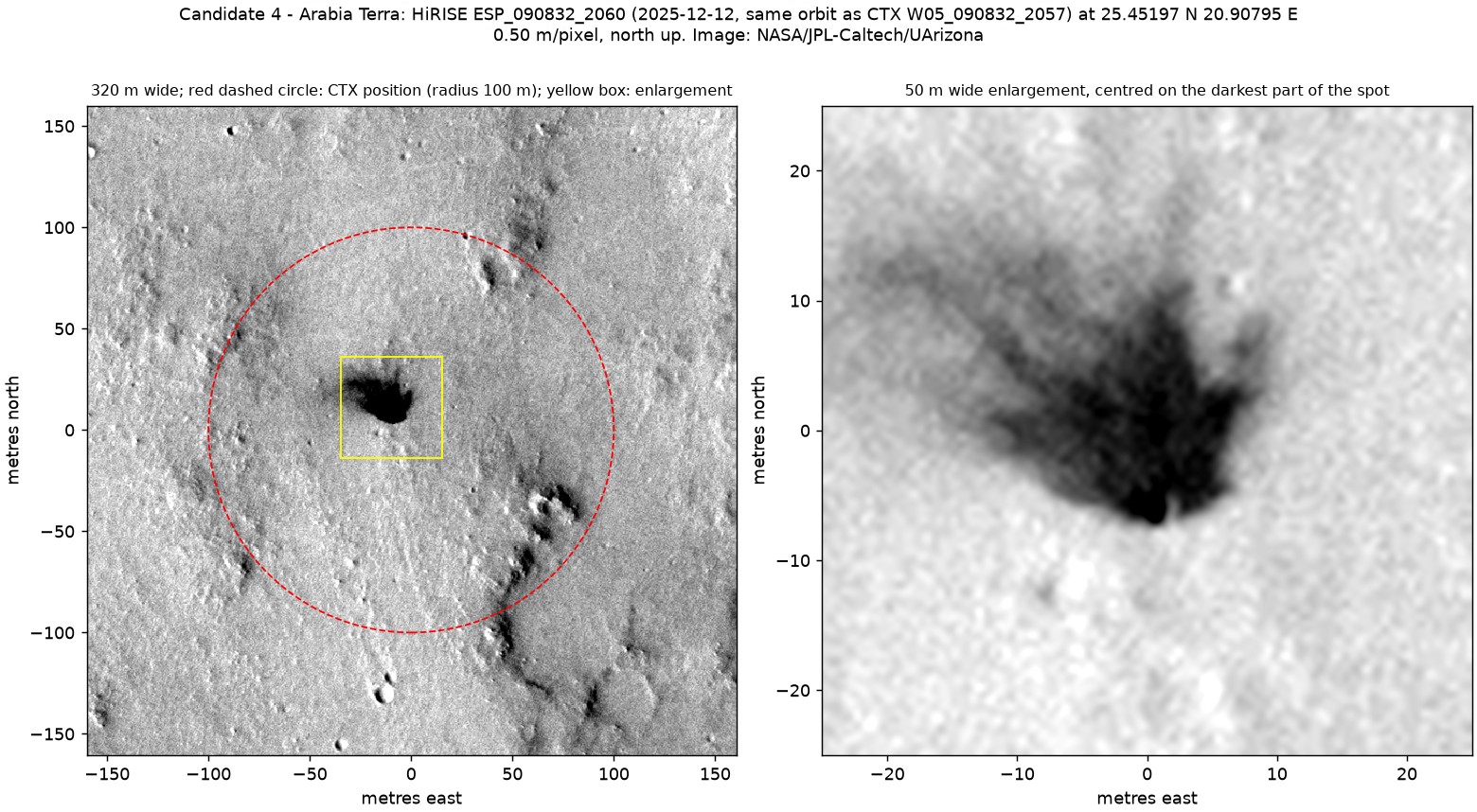
Why it may be a new impact. By chance, NASA’s HiRISE camera photographed it in December 2025. HiRISE shows a sharp-edged dark patch with finger-like margins on flat ground, with a tiny dark point at its edge: just what the blast zone of a fresh, very small crater looks like.

Location
25.452° N, 20.908° E
Absent
28 November 2010
Present
10 February 2025, 12 December 2025 (CTX and HiRISE) and 24 April 2026
Size
Dark splash about 30 m across
Confidence
Strong candidate; roughly 80% that it is a new impact.
Nearby
Candidate 12, 4.6 km away, appeared in the same time window.
Caveat
Like every candidate here, it is unconfirmed: see the caveat.
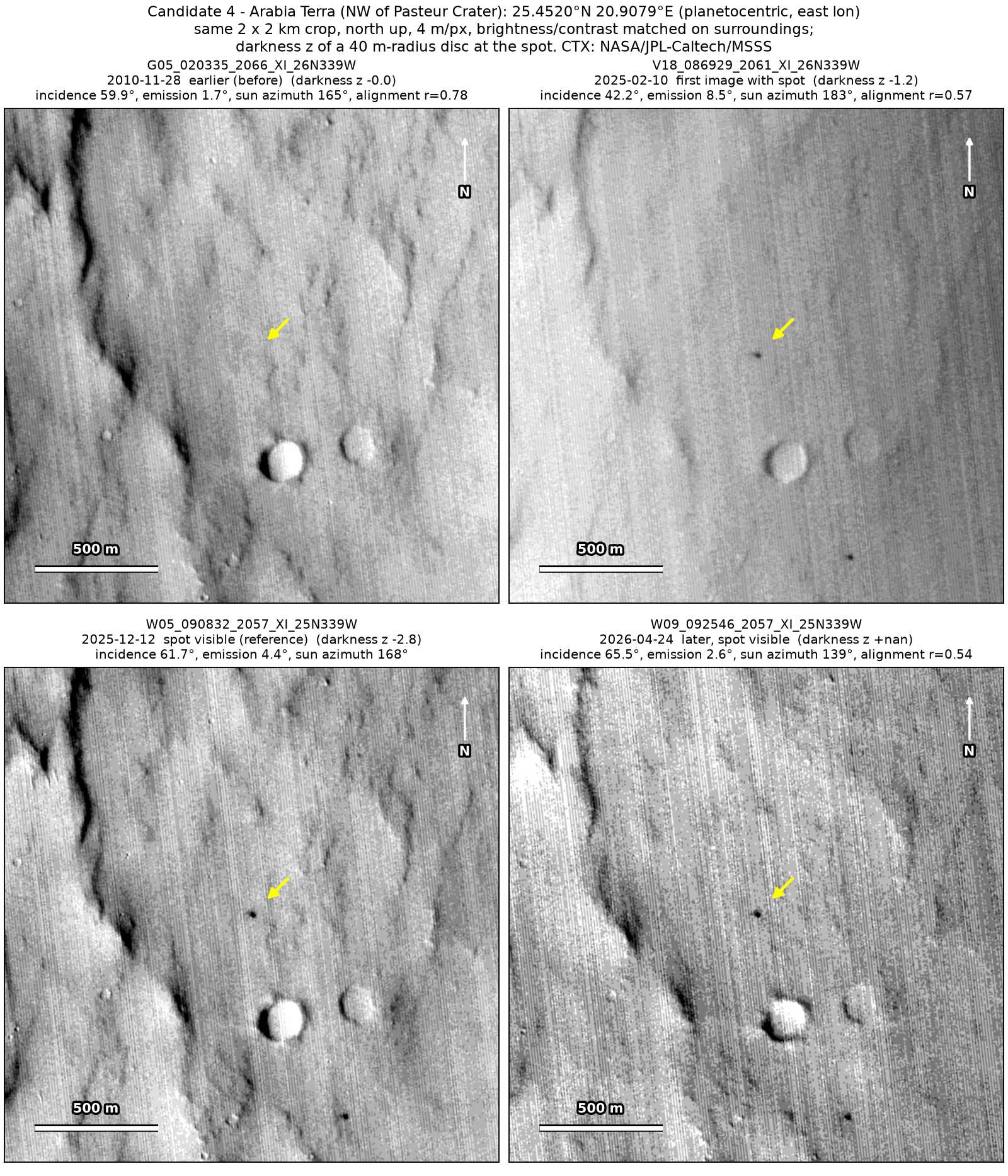
Four CTX images of the same 2 by 2 km patch of Arabia Terra, from 2010 to 2026. An arrow points to a small dark spot that is absent in 2010 and present in the three images from 2025 and 2026.
The four CTX images with data at the spot, 2010 to 2026: the same 2 × 2 km patch at the same scale and contrast. NASA/JPL-Caltech/MSSS.
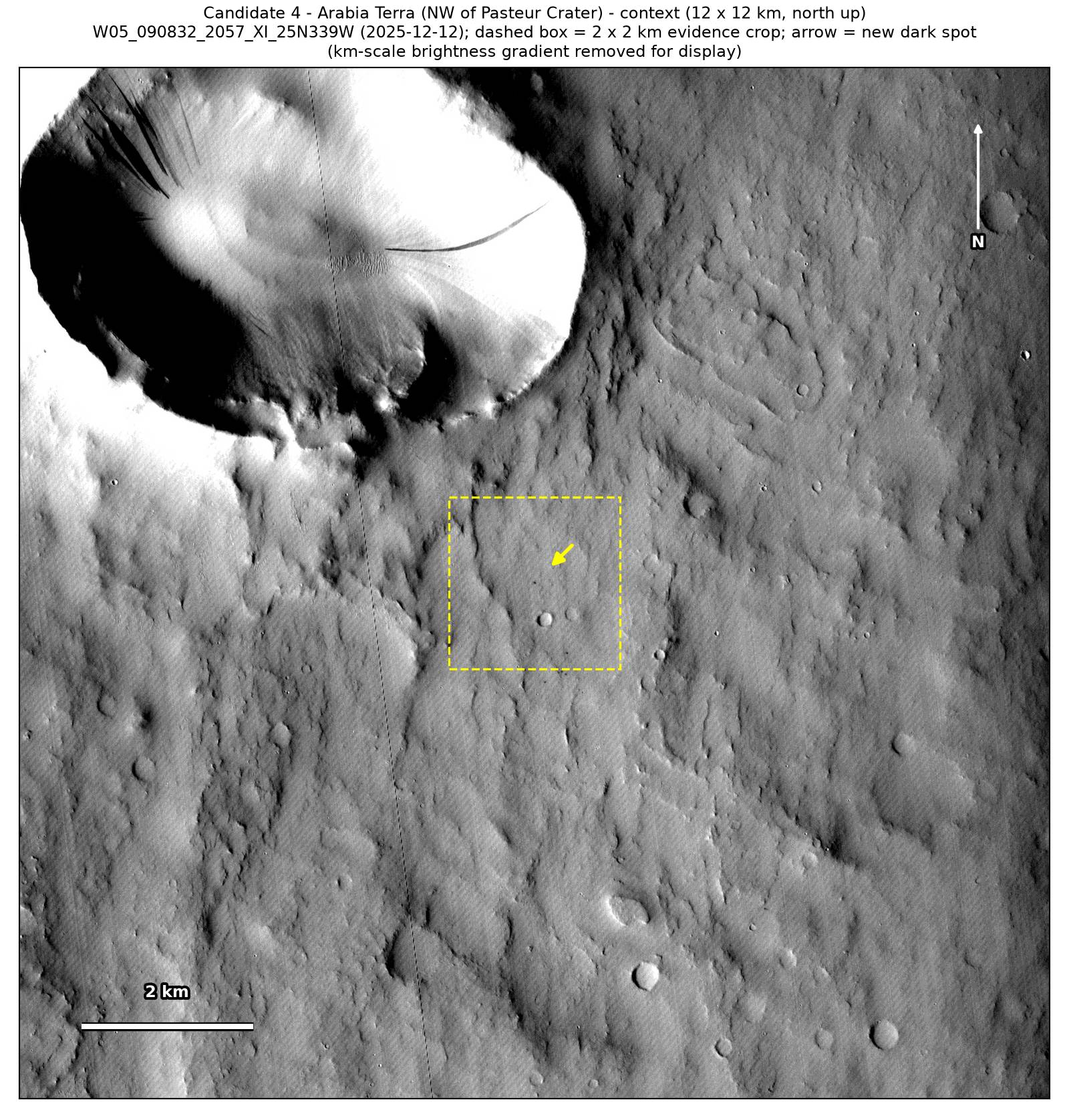
A 12 by 12 km CTX view from December 2025 around the Arabia Terra spot, with a dashed box around the 2 by 2 km patch and an arrow at the spot.
A 12 × 12 km view. The dashed box is the 2 × 2 km patch. NASA/JPL-Caltech/MSSS.
A HiRISE image from December 2025 showing a sharp-edged dark patch on flat ground inside a dashed circle that marks the CTX position, next to a 50 m wide enlargement of the patch with finger-like margins and a darker point at its southern edge.
HiRISE view of the spot (December 2025, 0.5 m per pixel), with a 50 m enlargement. NASA/JPL-Caltech/UArizona.

· All candidates ·