Professor of Mathematics

Paata Ivanisvili

pivanisv@uci.edu · x.com/PI010101

Department of Mathematics, University of California, Irvine

Paata Ivanisvili

← Possible new impact sites on Mars

Candidate 34: Central Ulysses Fossae, Tharsis lava plains

Strong · roughly 90%
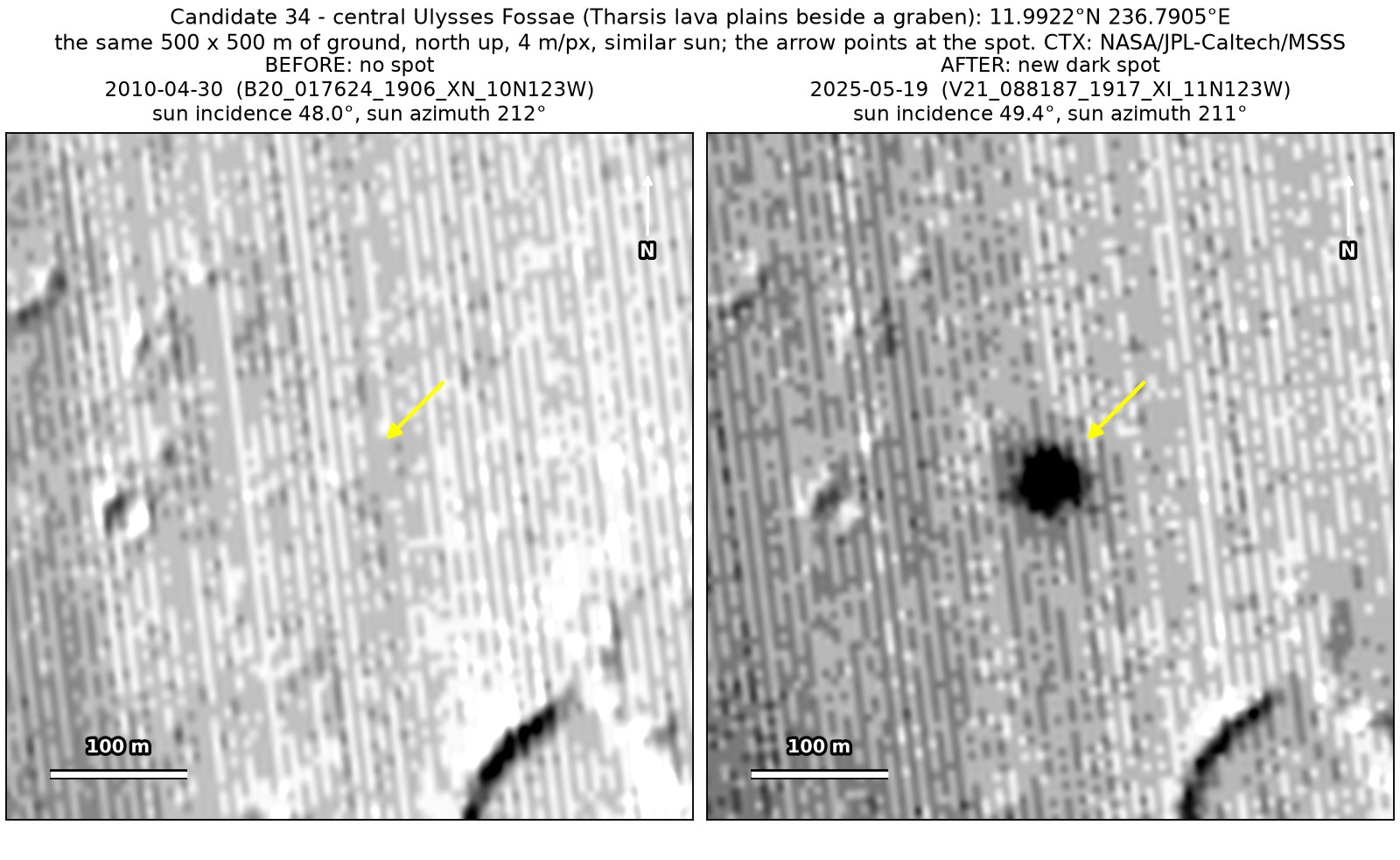
Two CTX close-ups of the same 500 by 500 m of lava plains in Ulysses Fossae, from April 2010 and May 2025, under the same sun. A very dark spot at the arrow is present only in the 2025 image.
The same 500 × 500 m in April 2010 and May 2025, under the same sun. The arrow marks the new spot. NASA/JPL-Caltech/MSSS.

What changed. A compact, very dark spot about 45 m across appeared on smooth lava plains beside a graben (a long fault trough) in central Ulysses Fossae, between April 2010 and October 2022. It is unchanged in three later images, up to May 2025, on four orbits in all.

Why it may be a new impact. An April 2010 image, taken under the same sun as the May 2025 one, would have shown it clearly and shows nothing. Later images, with the sun in many directions, show the same spot, so it is not a shadow; it is on flat ground, not on the graben’s wall, so it is not a slope streak; and two and a half years without change argue against a short-lived patch made by wind.

Location
11.992° N, 236.791° E (123.209° W)
Absent
30 April 2010
Present
9 October 2022, 2 December 2022, 20 March 2025 and 19 May 2025
Size
Compact, very dark spot about 45 m across
Confidence
Strong candidate; roughly 90% that it is a new impact.
Caveat
Only one earlier image exists, so the window is twelve years long. It first shows in a 2022 image, so the camera teams may already have it on their unpublished lists; but it lies outside every footprint of the high-resolution HiRISE camera, and the teams normally photograph a new impact with HiRISE within months of noticing it. Like every candidate here, it is unconfirmed: see the caveat.
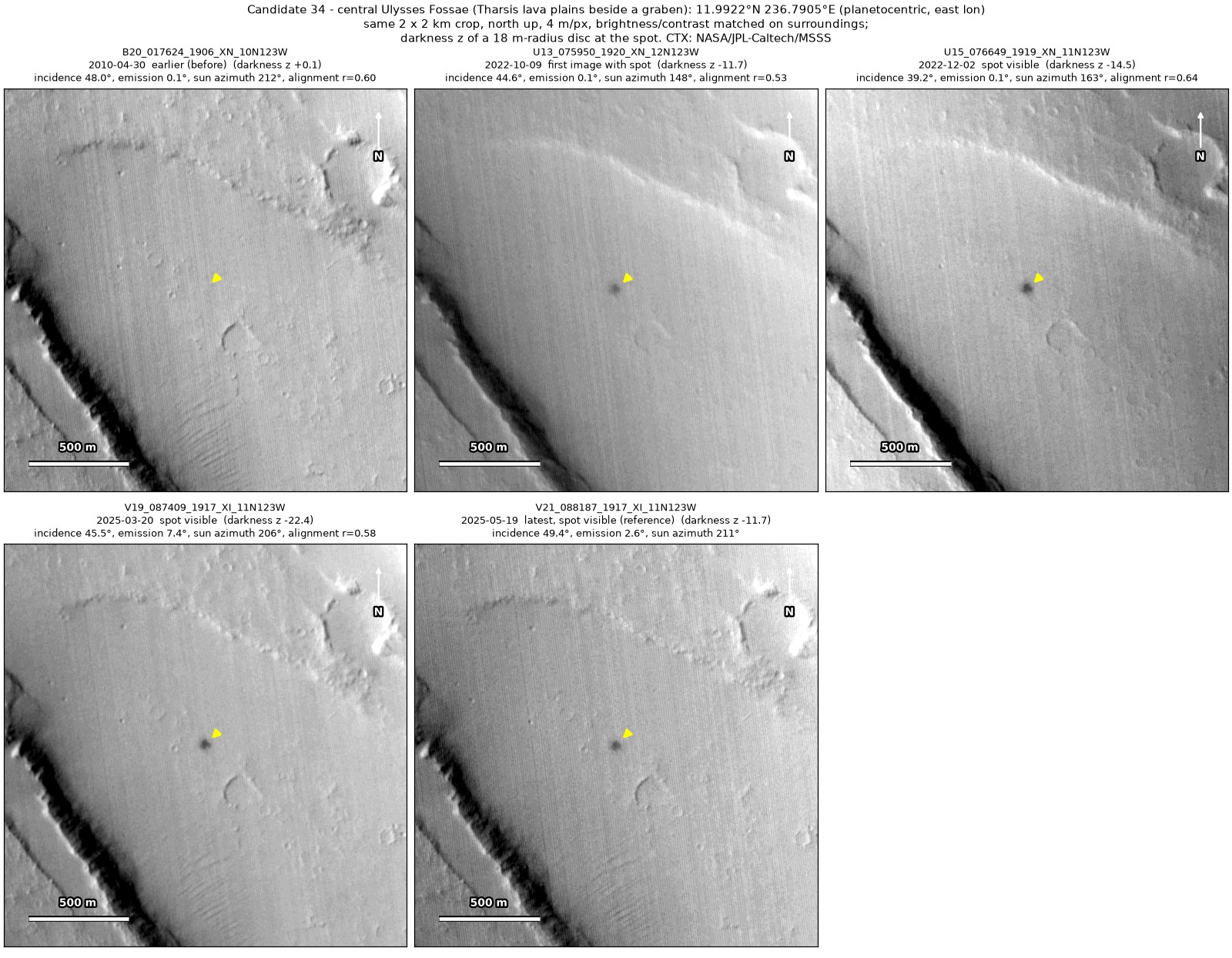
Five CTX images of the same 2 by 2 km patch of lava plains, from 2010 to 2025. A very dark spot at the arrow is absent in 2010 and present in the four images from 2022 and 2025.
All five CTX images of the same 2 × 2 km patch, 2010 to 2025. NASA/JPL-Caltech/MSSS.
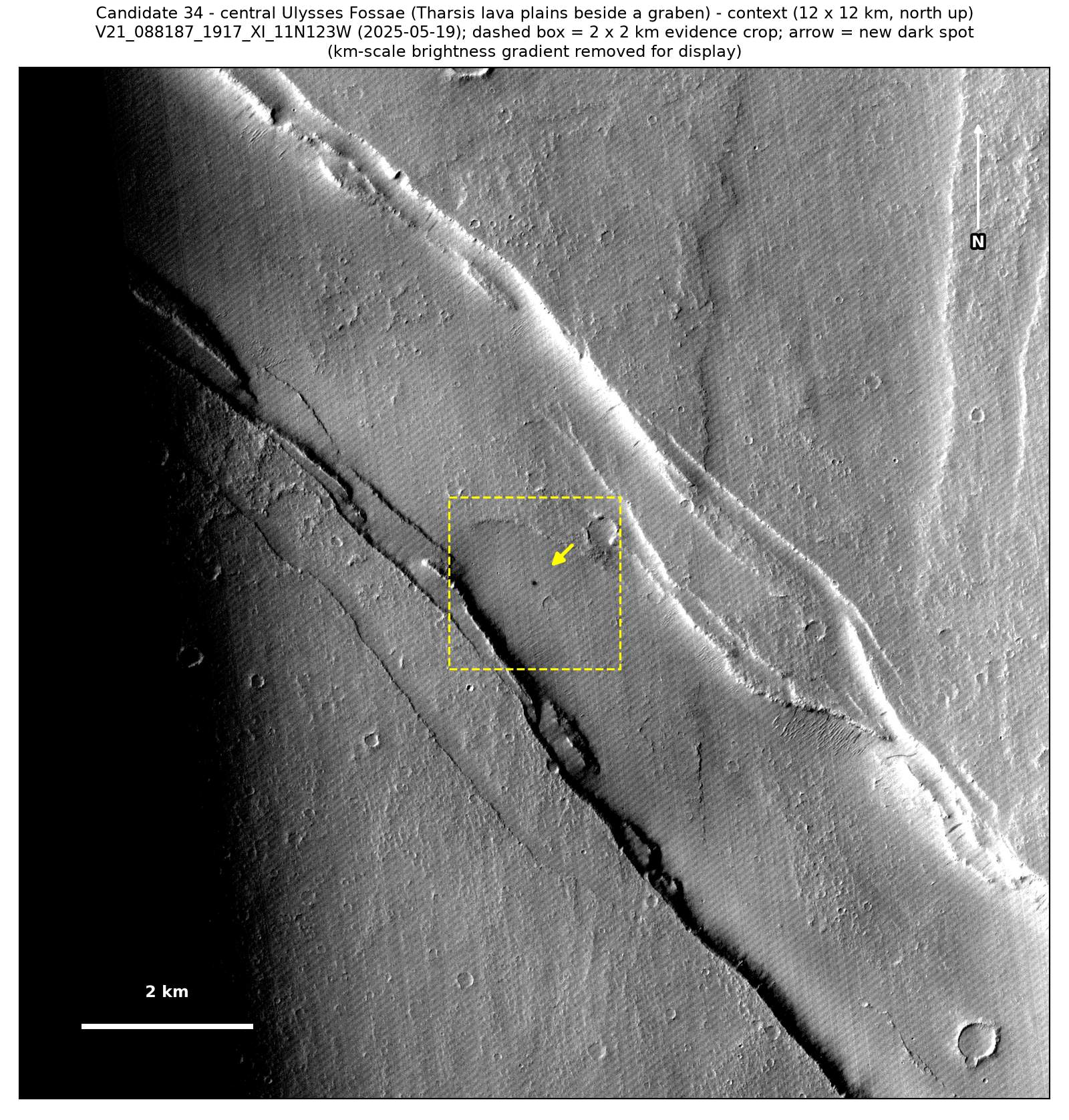
A 12 by 12 km CTX view from May 2025 of the lava plains and graben around the spot, with a dashed box around the 2 by 2 km patch and an arrow at the spot.
A 12 × 12 km view from May 2025. The dashed box is the 2 × 2 km patch. NASA/JPL-Caltech/MSSS.
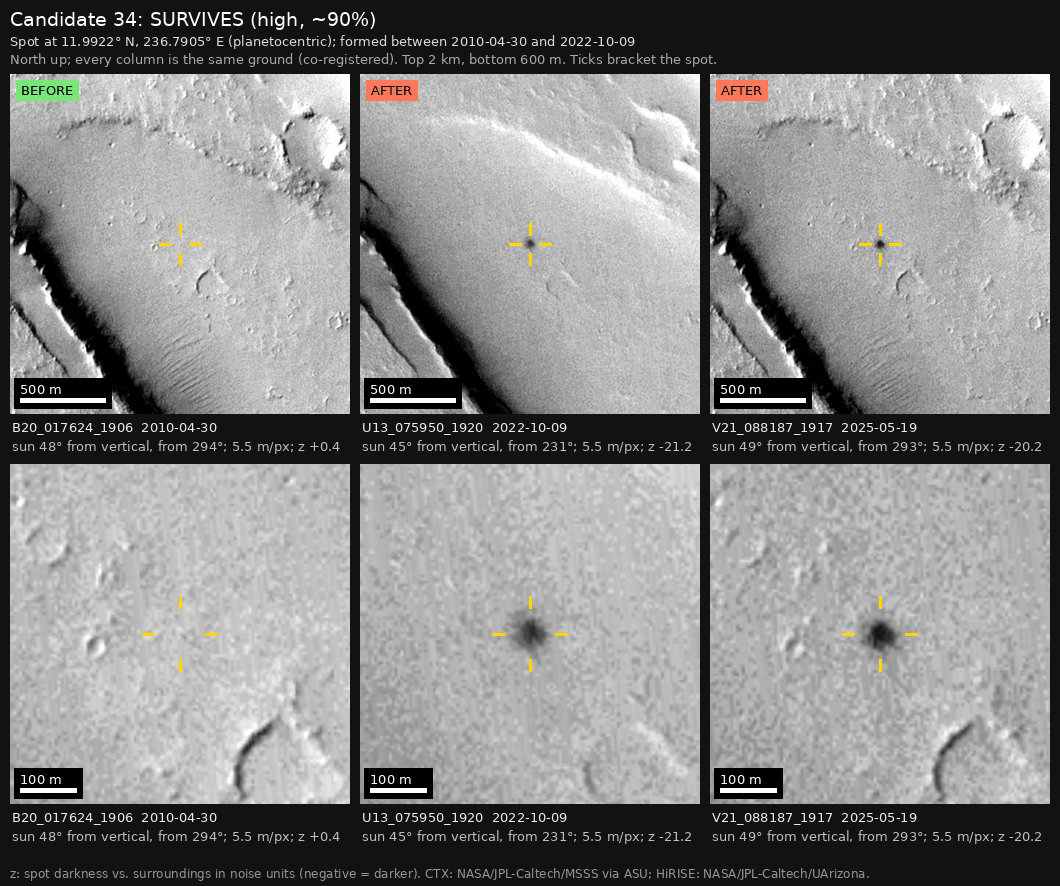
The independent check: three columns of the same ground, 2 km wide above and 600 m wide below, with yellow ticks around the spot. The spot is missing in the earlier image, marked BEFORE, and present in the two later images, marked AFTER.
Independent check. A second, deliberately sceptical review downloaded every image again and found that the candidate passes every test. Each column is the same ground, north up, 2 km wide above and 600 m wide below. Columns marked BEFORE are earlier images in which the spot would have been visible had it been there; those marked AFTER show it. Each image keeps one contrast stretch in both rows, so the close-up cannot create a spot. NASA/JPL-Caltech/MSSS.

· All candidates ·