Professor of Mathematics

Paata Ivanisvili

pivanisv@uci.edu · x.com/PI010101

Department of Mathematics, University of California, Irvine

Paata Ivanisvili

← Possible new impact sites on Mars

Candidate 30: Southern Arabia Terra, east of Schiaparelli crater

Strong · roughly 90%
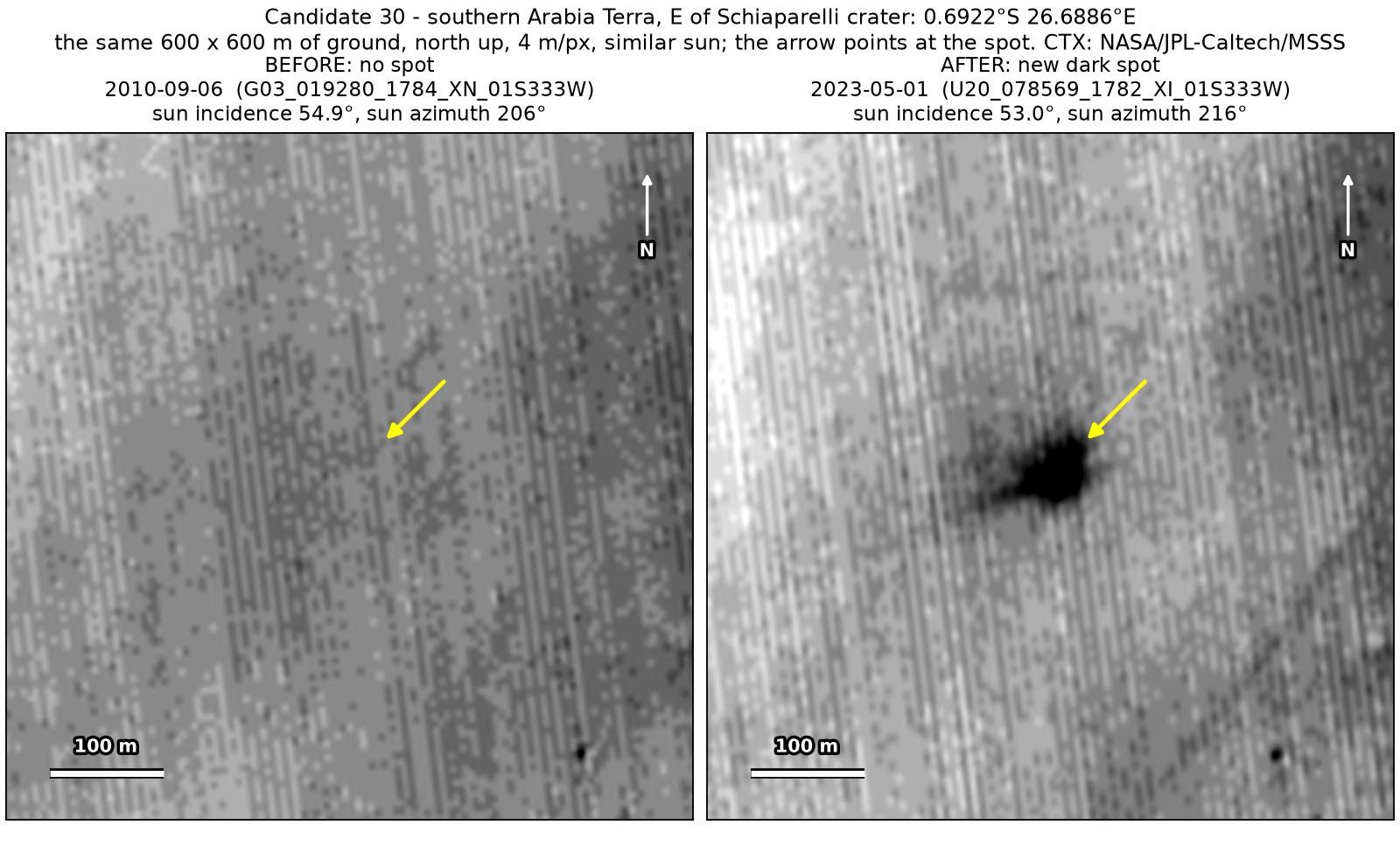
Two CTX close-ups of the same 600 by 600 m east of Schiaparelli crater, from September 2010 and May 2023, under the same sun. A very dark spot at the arrow is present only in the 2023 image.
The same 600 × 600 m in September 2010 and May 2023, under the same sun. The arrow marks the new spot. NASA/JPL-Caltech/MSSS.

What changed. A compact, very dark spot about 55 by 65 m appeared east of Schiaparelli crater between September 2010 and May 2023. It is still there in February 2025.

Why it may be a new impact. A September 2010 image under the same sun shows nothing there and would have shown it clearly. The same sun rules out a shadow and the ground is level, so it is not a slope streak; a compact, very dark spot unchanged for 21 months is the typical mark of a small impact.

Location
0.692° S, 26.689° E
Absent
6 September 2010
Present
1 May 2023 and 17 February 2025
Size
Compact, very dark spot about 55 × 65 m
Confidence
Strong candidate; roughly 90% that it is a new impact.
Caveat
Only one earlier image exists, so the window is almost 13 years long. It lies outside every footprint of the high-resolution HiRISE camera. Like every candidate here, it is unconfirmed: see the caveat.
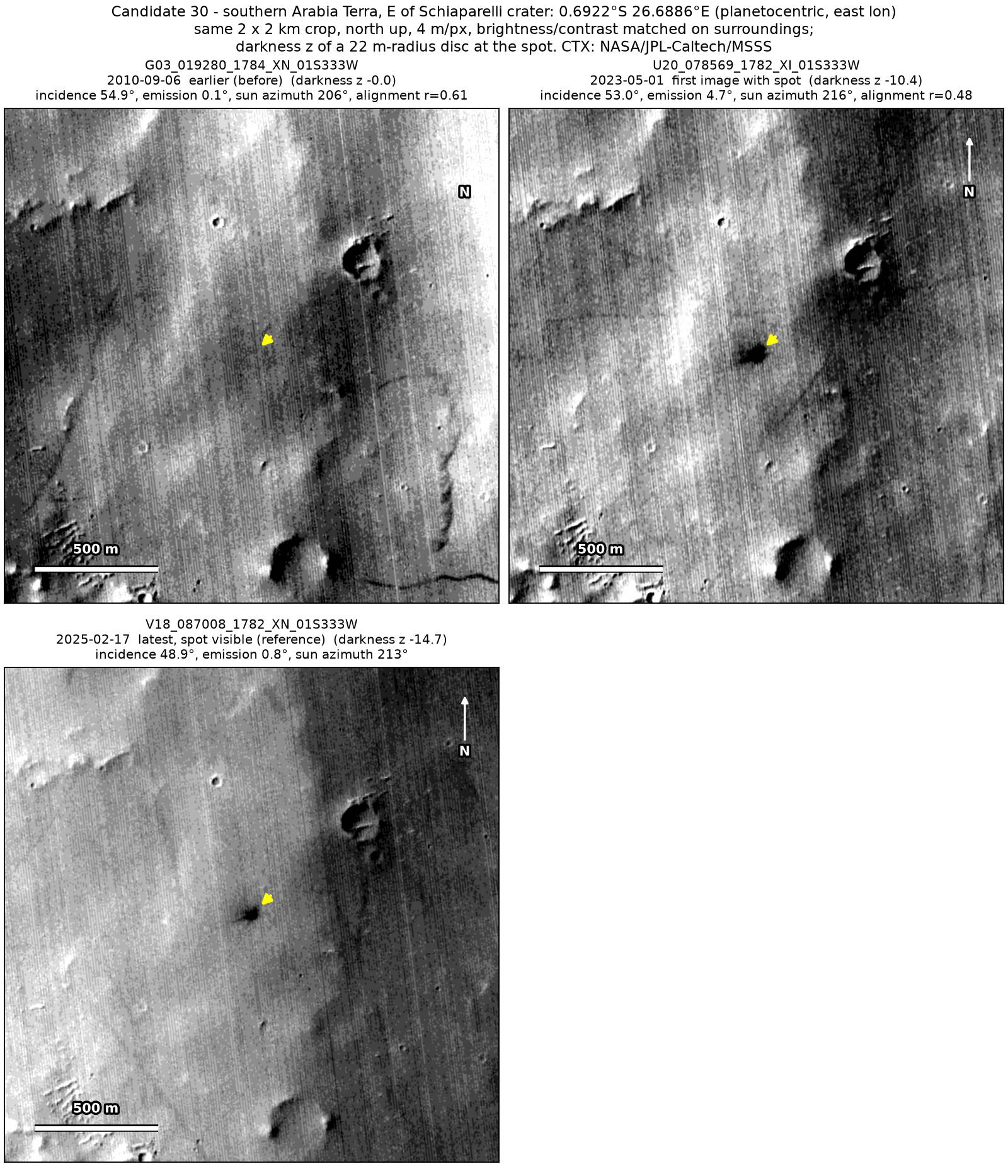
Three CTX images of the same 2 by 2 km patch, from 2010 to 2025. A very dark spot at the arrow is absent in 2010 and present in 2023 and 2025.
All three CTX images of the same 2 × 2 km patch, 2010 to 2025. NASA/JPL-Caltech/MSSS.
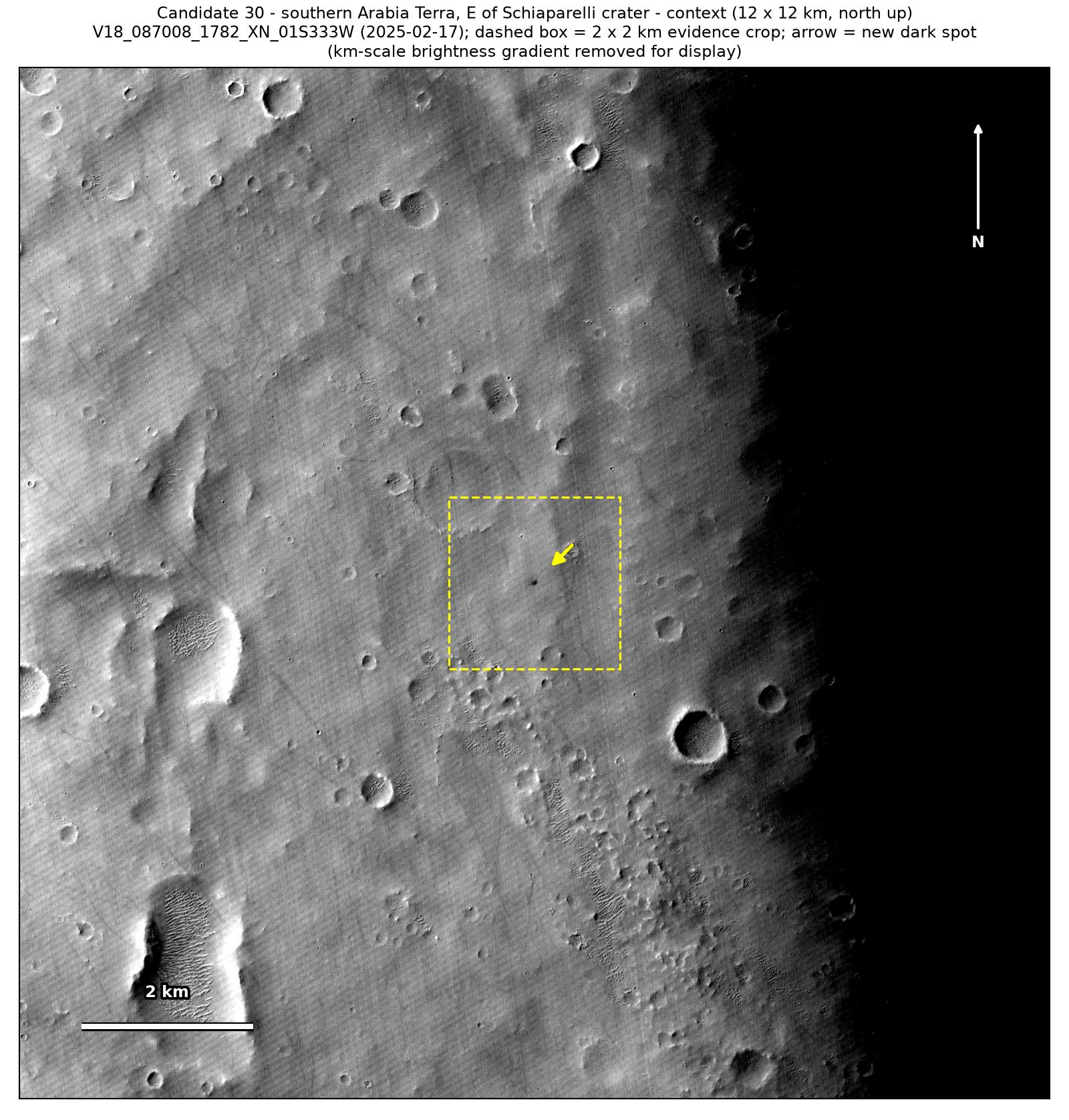
A 12 by 12 km CTX view from February 2025 of the ground east of Schiaparelli crater, with a dashed box around the 2 by 2 km patch and an arrow at the spot.
A 12 × 12 km view from February 2025. The dashed box is the 2 × 2 km patch. NASA/JPL-Caltech/MSSS.
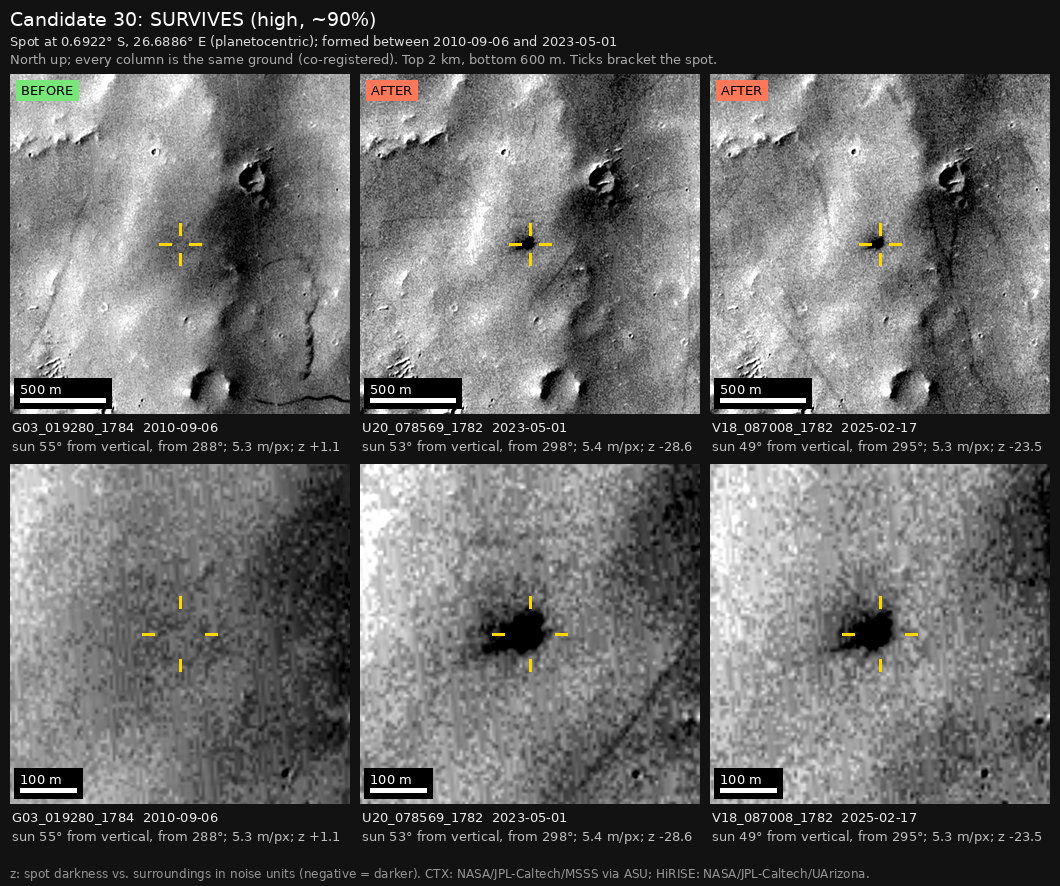
The independent check: three columns of the same ground, 2 km wide above and 600 m wide below, with yellow ticks around the spot. The spot is missing in the earlier image, marked BEFORE, and present in the two later images, marked AFTER.
Independent check. A second, deliberately sceptical review downloaded every image again and found that the candidate passes every test. Each column is the same ground, north up, 2 km wide above and 600 m wide below. Columns marked BEFORE are earlier images in which the spot would have been visible had it been there; those marked AFTER show it. Each image keeps one contrast stretch in both rows, so the close-up cannot create a spot. NASA/JPL-Caltech/MSSS.

· All candidates ·