Professor of Mathematics

Paata Ivanisvili

pivanisv@uci.edu · x.com/PI010101

Department of Mathematics, University of California, Irvine

Paata Ivanisvili

← Possible new impact sites on Mars

Candidate 29: Rippled ground west of Echus Chasma

Strong · roughly 85%
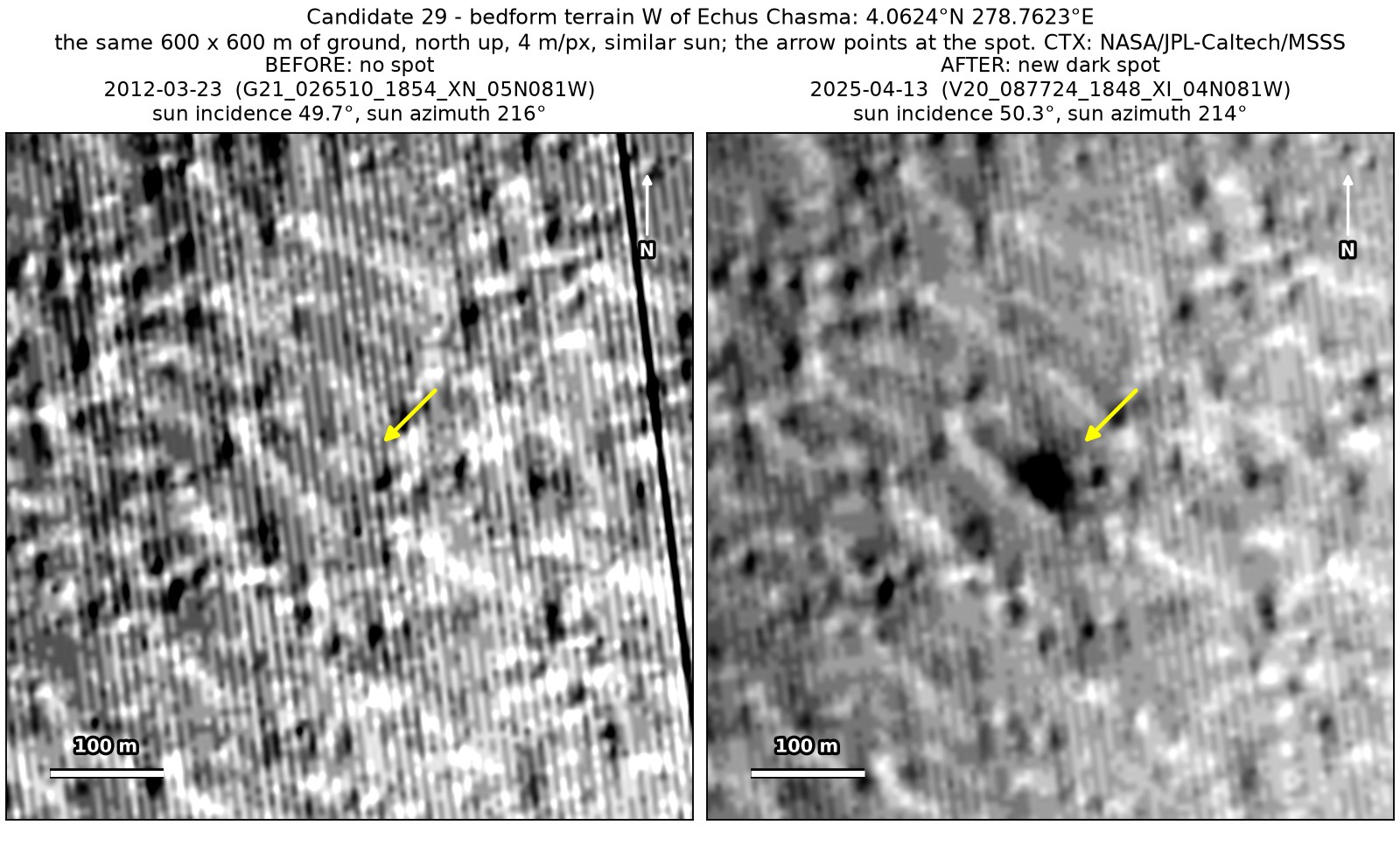
Two CTX close-ups of the same 600 by 600 m of rippled ground west of Echus Chasma, from March 2012 and April 2025, under the same sun. A compact dark spot at the arrow is present only in the 2025 image.
The same 600 × 600 m in March 2012 and April 2025, under the same sun. The arrow marks the new spot. NASA/JPL-Caltech/MSSS.

What changed. A compact dark spot about 50 m across appeared on rippled ground west of Echus Chasma, between March 2012 and March 2023. It is in four images from four orbits, from March 2023 to July 2025.

Why it may be a new impact. Images from 2007 and 2012 show nothing there; the 2012 image was taken under the same sun as one from 2025. Dark sand gathering between ripples would follow the ripple pattern, but this spot is round and has not moved or changed in more than two years, while the ripple crests line up in every image.

Location
4.062° N, 278.762° E (81.238° W)
Absent
6 April 2007 and 23 March 2012
Present
29 March 2023, 12 February 2025, 13 April 2025 and 6 July 2025
Size
Compact dark spot about 50 m across
Confidence
Strong candidate; roughly 85% that it is a new impact.
Nearby
Candidate 36, 91 km to the south, first shows in the same image of 29 March 2023, and candidate 32 is about 220 km away. All three are near Echus Chasma, but they are separate events: no single meteoroid scatters craters that far apart.
Caveat
It lies outside every footprint of the high-resolution HiRISE camera. Like every candidate here, it is unconfirmed: see the caveat.
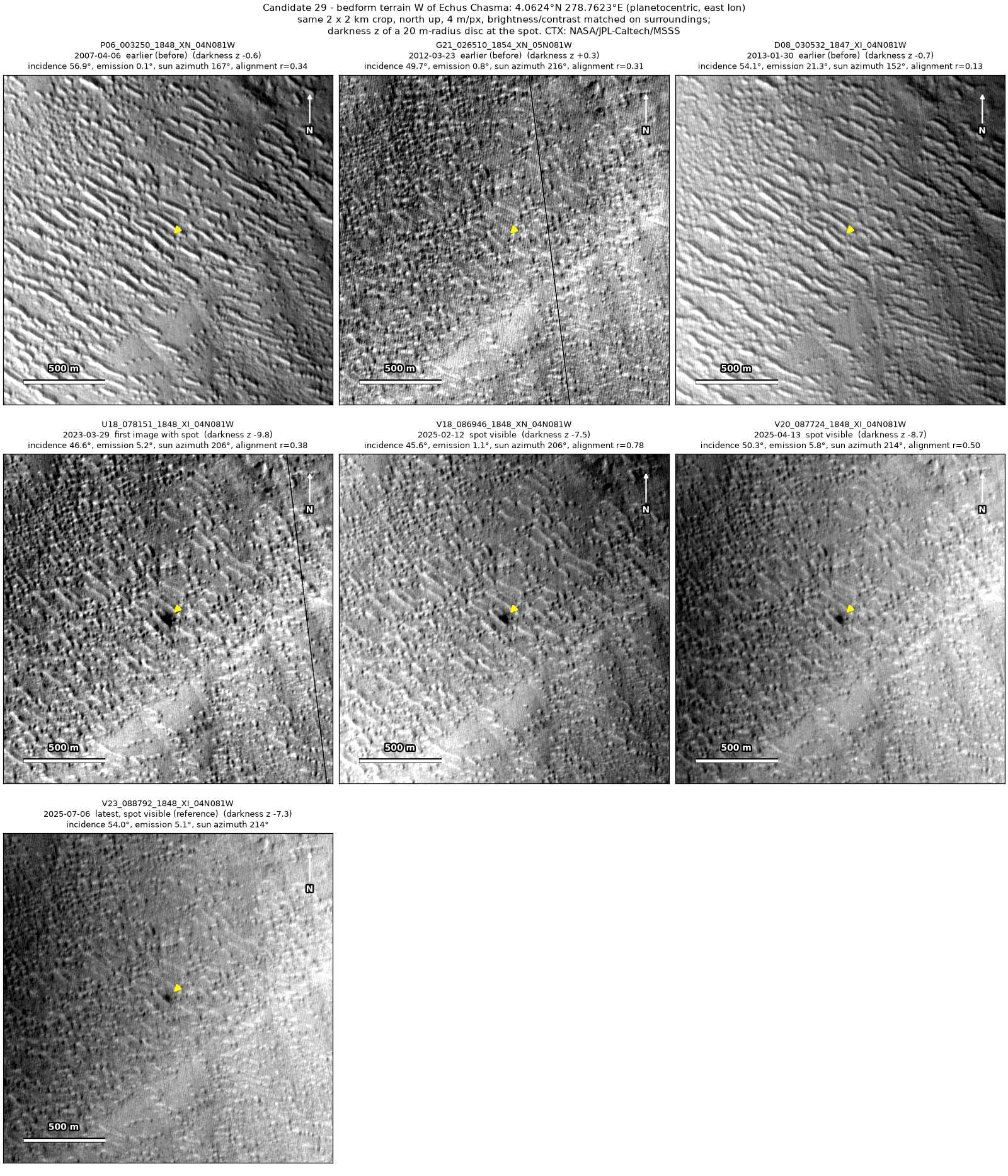
Seven CTX images of the same 2 by 2 km patch of rippled ground, from 2007 to 2025. A compact dark spot at the arrow is absent in 2007, 2012 and 2013 and present in the four images from 2023 and 2025.
All seven CTX images of the same 2 × 2 km patch, 2007 to 2025. The January 2013 image is too oblique to count. NASA/JPL-Caltech/MSSS.
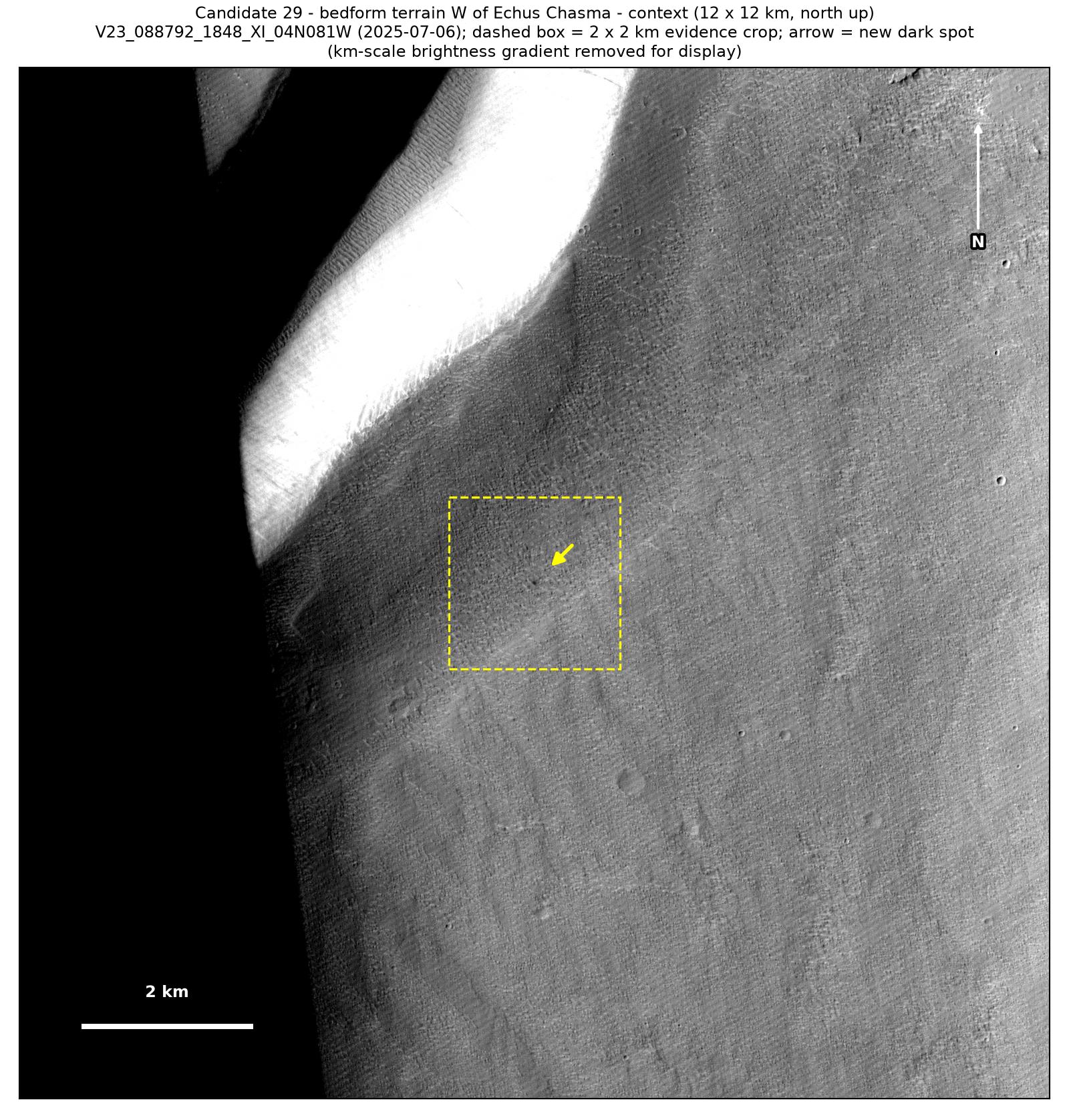
A 12 by 12 km CTX view from July 2025 of the rippled ground around the spot, with a dashed box around the 2 by 2 km patch and an arrow at the spot.
A 12 × 12 km view from July 2025. The dashed box is the 2 × 2 km patch. NASA/JPL-Caltech/MSSS.
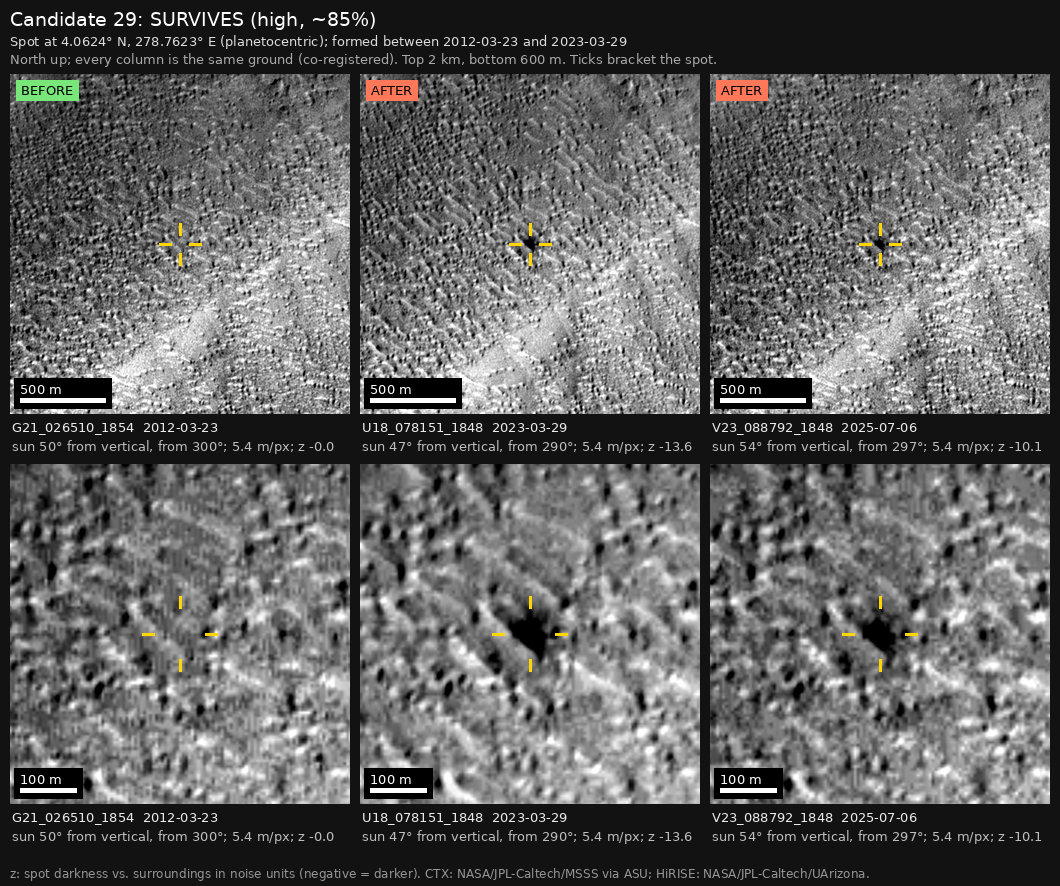
The independent check: three columns of the same ground, 2 km wide above and 600 m wide below, with yellow ticks around the spot. The spot is missing in the earlier image, marked BEFORE, and present in the two later images, marked AFTER.
Independent check. A second, deliberately sceptical review downloaded every image again and found that the candidate passes every test. Each column is the same ground, north up, 2 km wide above and 600 m wide below. Columns marked BEFORE are earlier images in which the spot would have been visible had it been there; those marked AFTER show it. Each image keeps one contrast stretch in both rows, so the close-up cannot create a spot. NASA/JPL-Caltech/MSSS.

· All candidates ·