Professor of Mathematics

Paata Ivanisvili

pivanisv@uci.edu · x.com/PI010101

Department of Mathematics, University of California, Irvine

Paata Ivanisvili

← Possible new impact sites on Mars

Candidate 22: Elysium Planitia, west of Athabasca Valles

Strong · roughly 85%
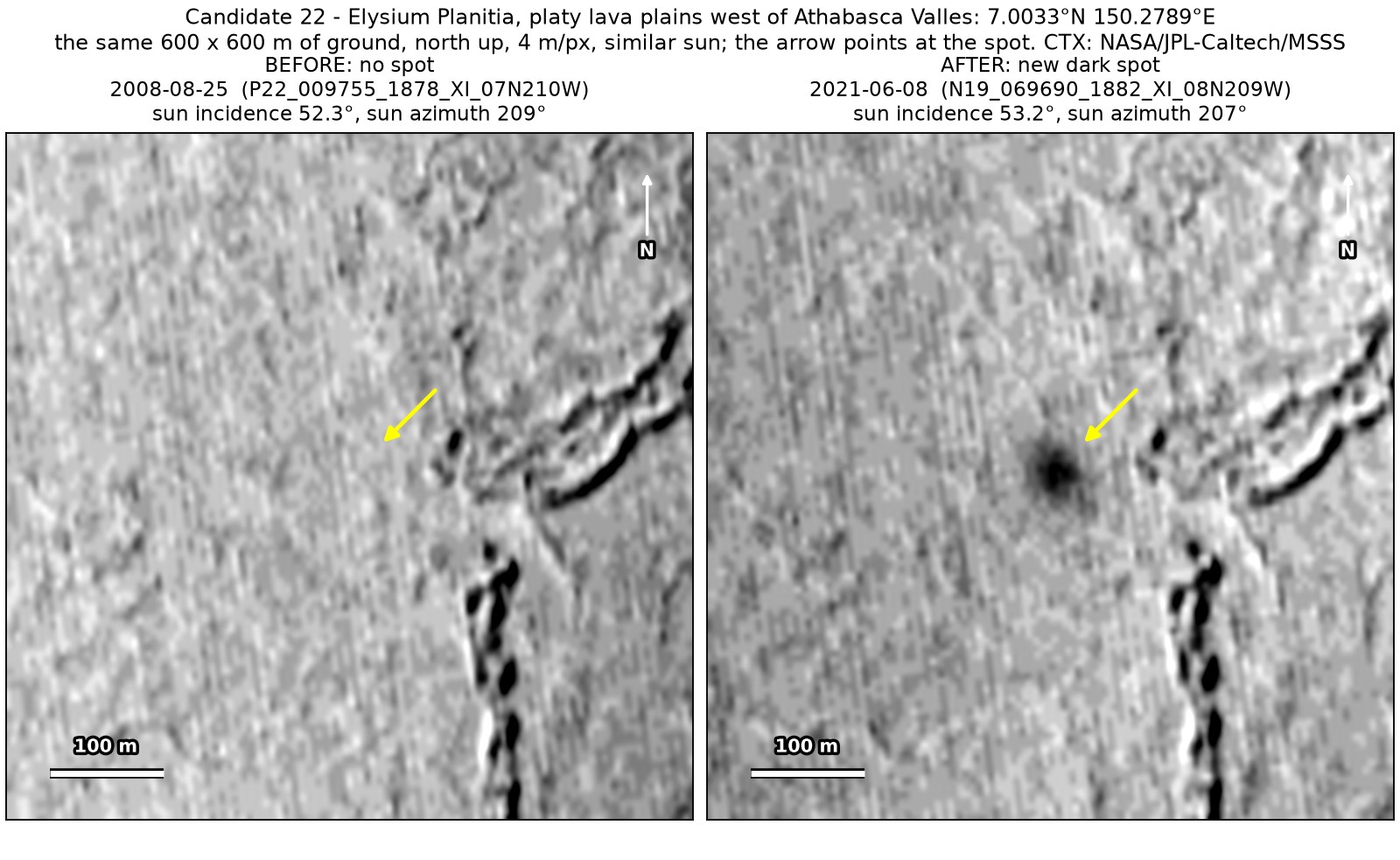
Two CTX close-ups of the same 600 by 600 m of lava plates west of Athabasca Valles, from August 2008 and June 2021, under a similar sun. A dark spot with a faint halo at the arrow is present only in the 2021 image.
The same 600 × 600 m in August 2008 and June 2021, under a similar sun. The arrow marks the new spot. NASA/JPL-Caltech/MSSS.

What changed. A dark core 25 to 30 m across, inside a halo about 100 m across, appeared on flat lava plates west of Athabasca Valles between August 2008 and June 2021. It is in all five images since, from five orbits: very dark until 2025 and fainter in 2026.

Why it may be a new impact. The August 2008 image, taken under the same sun as the 2021 one, would have shown it clearly and shows nothing. Five orbits and varied sun directions rule out shadows, frost and camera glitches, and a round core-and-halo spot that fades slowly is how impact scars behave. The window is long only because no CTX image was taken in between.

Location
7.003° N, 150.279° E
Absent
25 August 2008
Present
five images from 8 June 2021 to 3 May 2026
Size
Dark core 25 to 30 m across, inside a halo about 100 m across
Confidence
Strong candidate; roughly 85% that it is a new impact.
Caveat
It is the one candidate that matches both the area and the dates searched by a catalogue of new impacts near the InSight lander (Bickel et al. 2025), which could not be downloaded, so it may already be listed there. That is less likely because, five years on, it still lies outside every footprint of the high-resolution HiRISE camera, and the catalogue’s authors request a HiRISE image of every impact they confirm. Like every candidate here, it is unconfirmed: see the caveat.
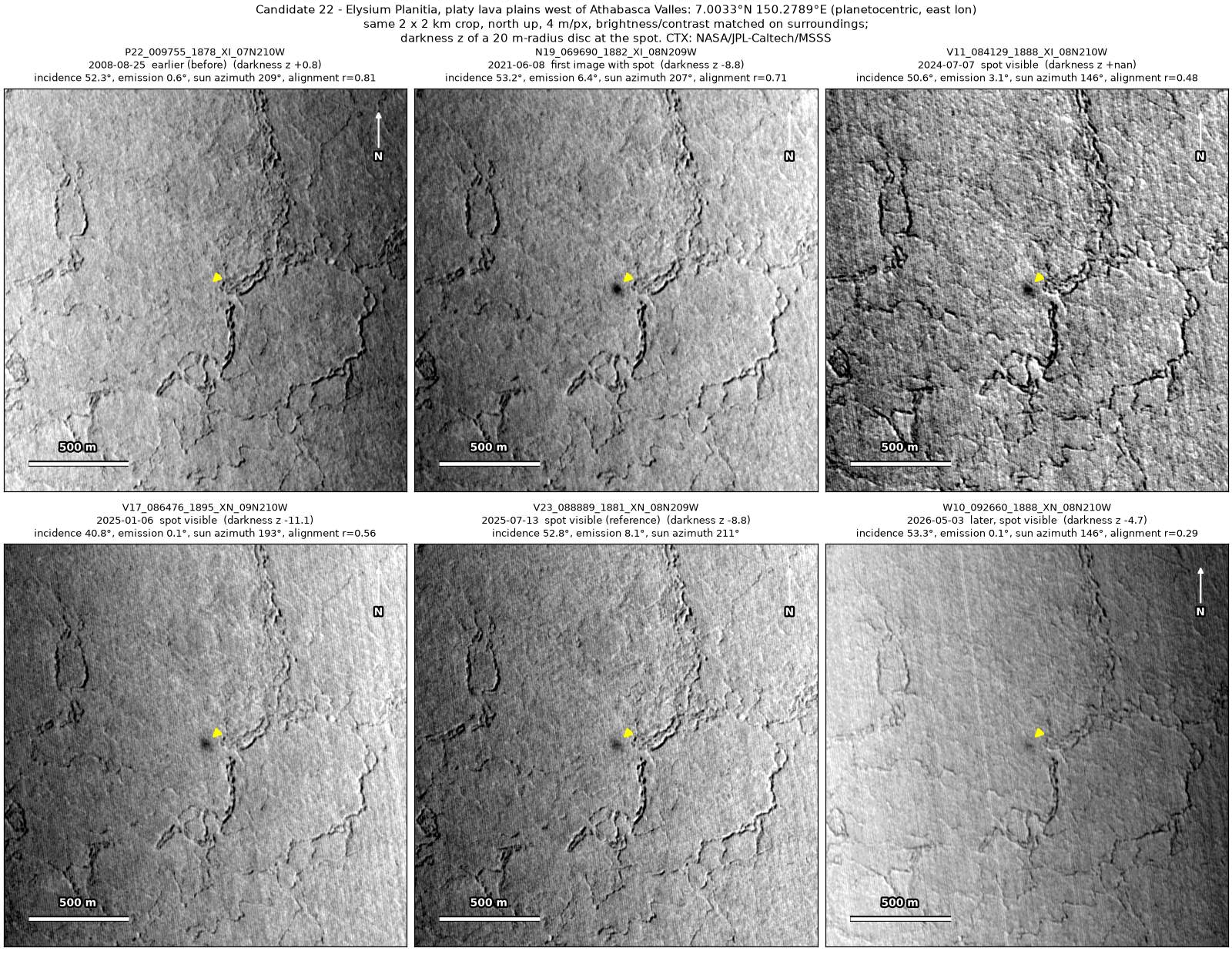
Six CTX images of the same 2 by 2 km patch, from 2008 to 2026. A dark spot with a halo at the arrow is absent in 2008 and present in the five images from 2021 to 2026, fainter in the last.
All six CTX images of the same 2 × 2 km patch, 2008 to 2026. NASA/JPL-Caltech/MSSS.
A 12 by 12 km CTX view from July 2025 of the lava plates around the spot, with a dashed box around the 2 by 2 km patch and an arrow at the spot.
A 12 × 12 km view from July 2025. The dashed box is the 2 × 2 km patch. NASA/JPL-Caltech/MSSS.
The independent check: three columns of the same ground, 2 km wide above and 600 m wide below, with yellow ticks around the spot. The spot is missing in the earlier image, marked BEFORE, and present in the two later images, marked AFTER.
Independent check. A second, deliberately sceptical review downloaded every image again and found that the candidate passes every test. Each column is the same ground, north up, 2 km wide above and 600 m wide below. Columns marked BEFORE are earlier images in which the spot would have been visible had it been there; those marked AFTER show it. Each image keeps one contrast stretch in both rows, so the close-up cannot create a spot. NASA/JPL-Caltech/MSSS.

· All candidates ·