Professor of Mathematics

Paata Ivanisvili

pivanisv@uci.edu · x.com/PI010101

Department of Mathematics, University of California, Irvine

Paata Ivanisvili

← Possible new impact sites on Mars

Candidate 21: Eastern Ulysses Fossae, Tharsis lava plains

Strong · roughly 90%
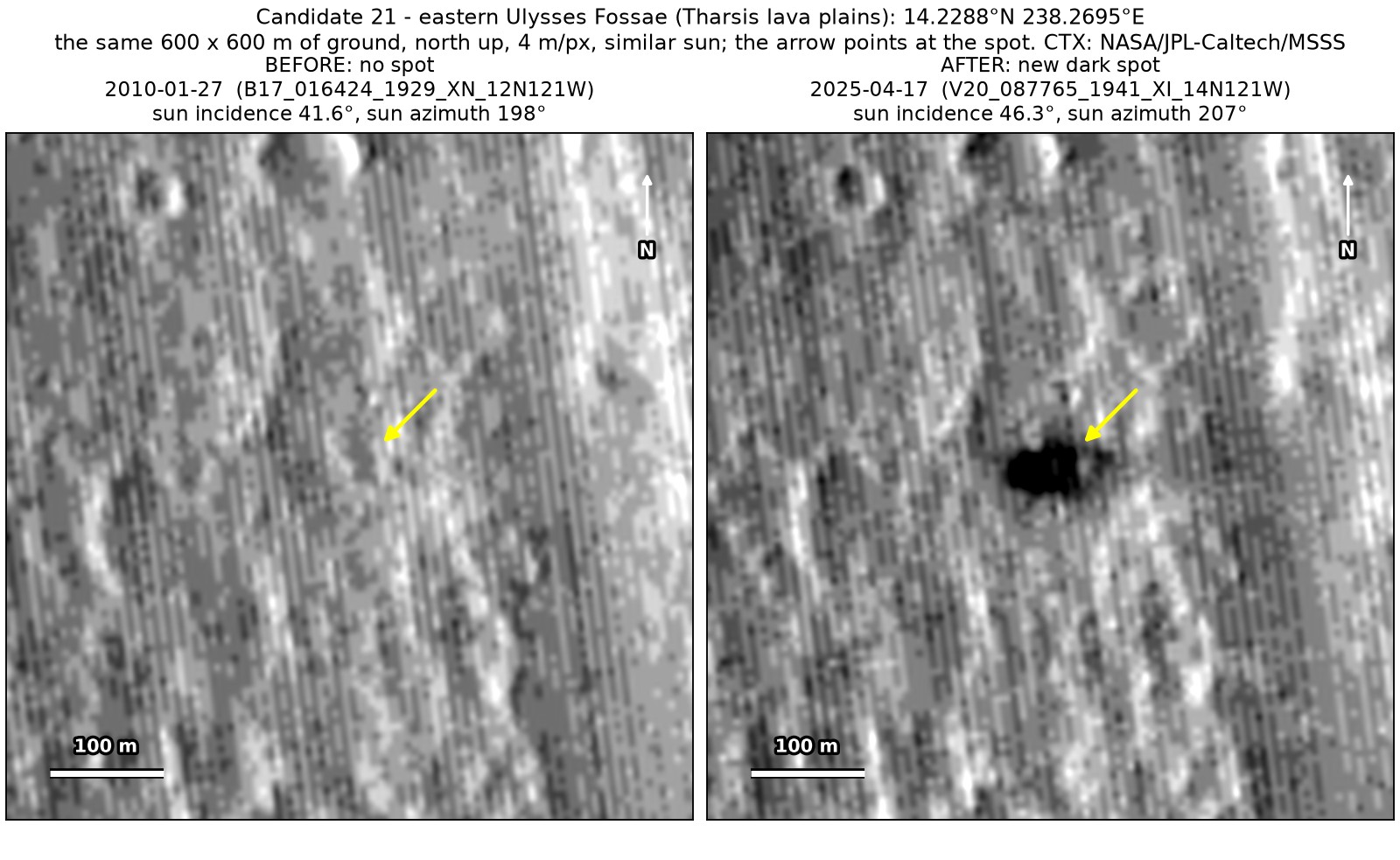
Two CTX close-ups of the same 600 by 600 m of smooth lava plains, from January 2010 and April 2025, under a similar sun. A compact dark spot at the arrow is present only in the 2025 image.
The same 600 × 600 m in January 2010 and April 2025, under a similar sun. The arrow marks the new spot. NASA/JPL-Caltech/MSSS.

What changed. A compact dark spot about 70 by 55 m appeared on smooth lava plains in eastern Ulysses Fossae, between March 2019 and March 2024. It has not changed in five images from five orbits, up to July 2025.

Why it may be a new impact. Images from January 2010 and March 2019 show nothing there, and both would have shown it. There is no pit, knob or crater at the spot to cast a shadow; the ground is flat, so it is not a slope streak; and the spot is compact, not a line like a dust-devil track. A new impact scar is the natural explanation.

Location
14.229° N, 238.270° E (121.730° W)
Absent
27 January 2010 and 19 March 2019
Present
five images from 19 March 2024 to 9 July 2025
Size
Compact dark spot about 70 × 55 m
Confidence
Strong candidate; roughly 90% that it is a new impact.
Caveat
It lies outside every footprint of the high-resolution HiRISE camera. Like every candidate here, it is unconfirmed: see the caveat.
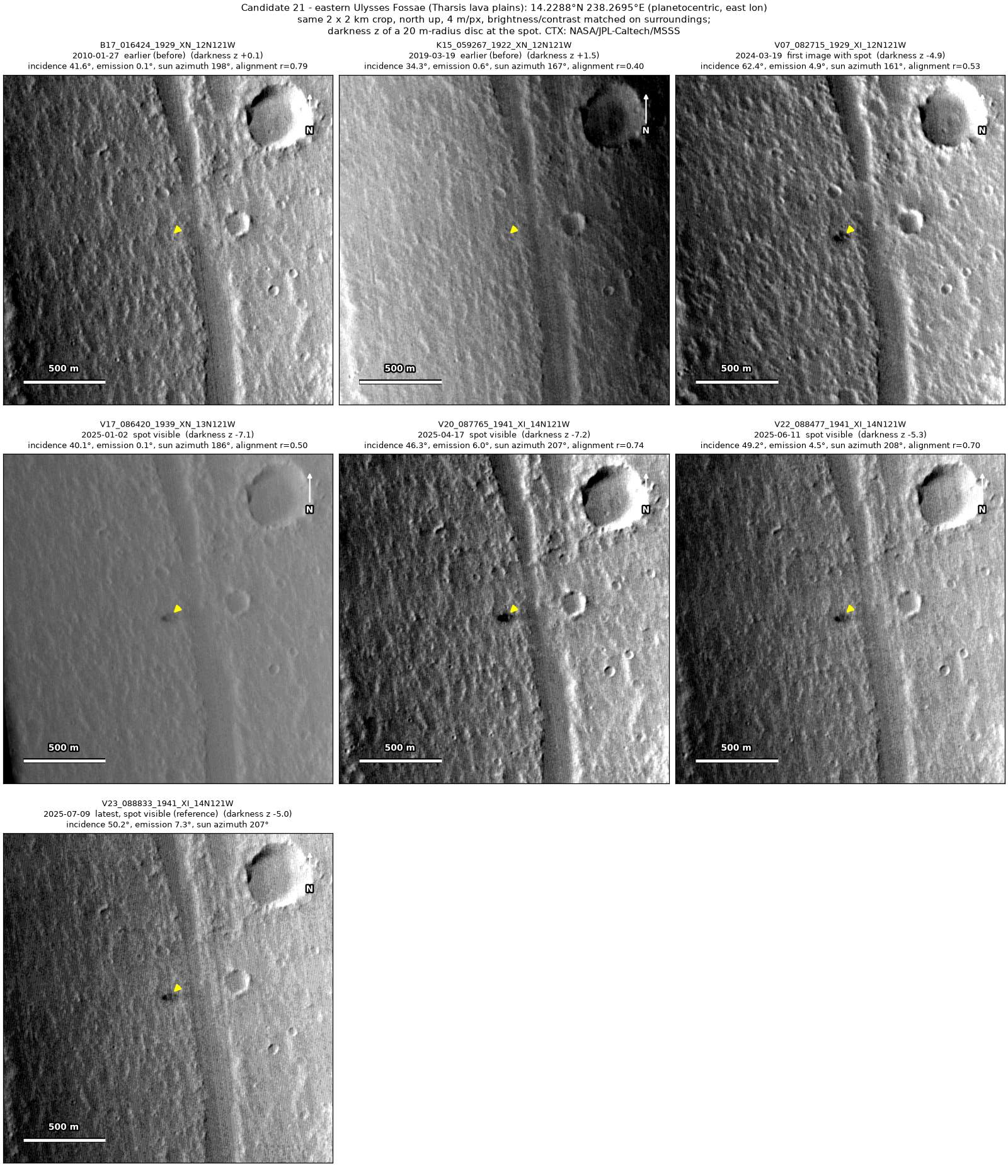
Seven CTX images of the same 2 by 2 km patch of lava plains, from 2010 to 2025. A compact dark spot at the arrow is absent in 2010 and 2019 and present in the five images from 2024 and 2025.
All seven CTX images of the same 2 × 2 km patch, 2010 to 2025. NASA/JPL-Caltech/MSSS.
A 12 by 12 km CTX view from July 2025 of the lava plains around the spot, with a dashed box around the 2 by 2 km patch and an arrow at the spot.
A 12 × 12 km view from July 2025. The dashed box is the 2 × 2 km patch. NASA/JPL-Caltech/MSSS.
The independent check: three columns of the same ground, 2 km wide above and 600 m wide below, with yellow ticks around the spot. The spot is missing in the earlier image, marked BEFORE, and present in the two later images, marked AFTER.
Independent check. A second, deliberately sceptical review downloaded every image again and found that the candidate passes every test. Each column is the same ground, north up, 2 km wide above and 600 m wide below. Columns marked BEFORE are earlier images in which the spot would have been visible had it been there; those marked AFTER show it. Each image keeps one contrast stretch in both rows, so the close-up cannot create a spot. NASA/JPL-Caltech/MSSS.

· All candidates ·