Professor of Mathematics

Paata Ivanisvili

pivanisv@uci.edu · x.com/PI010101

Department of Mathematics, University of California, Irvine

Paata Ivanisvili

← Possible new impact sites on Mars

Candidate 15: Giant lava lobe north of Pavonis Mons

Strong · roughly 90%
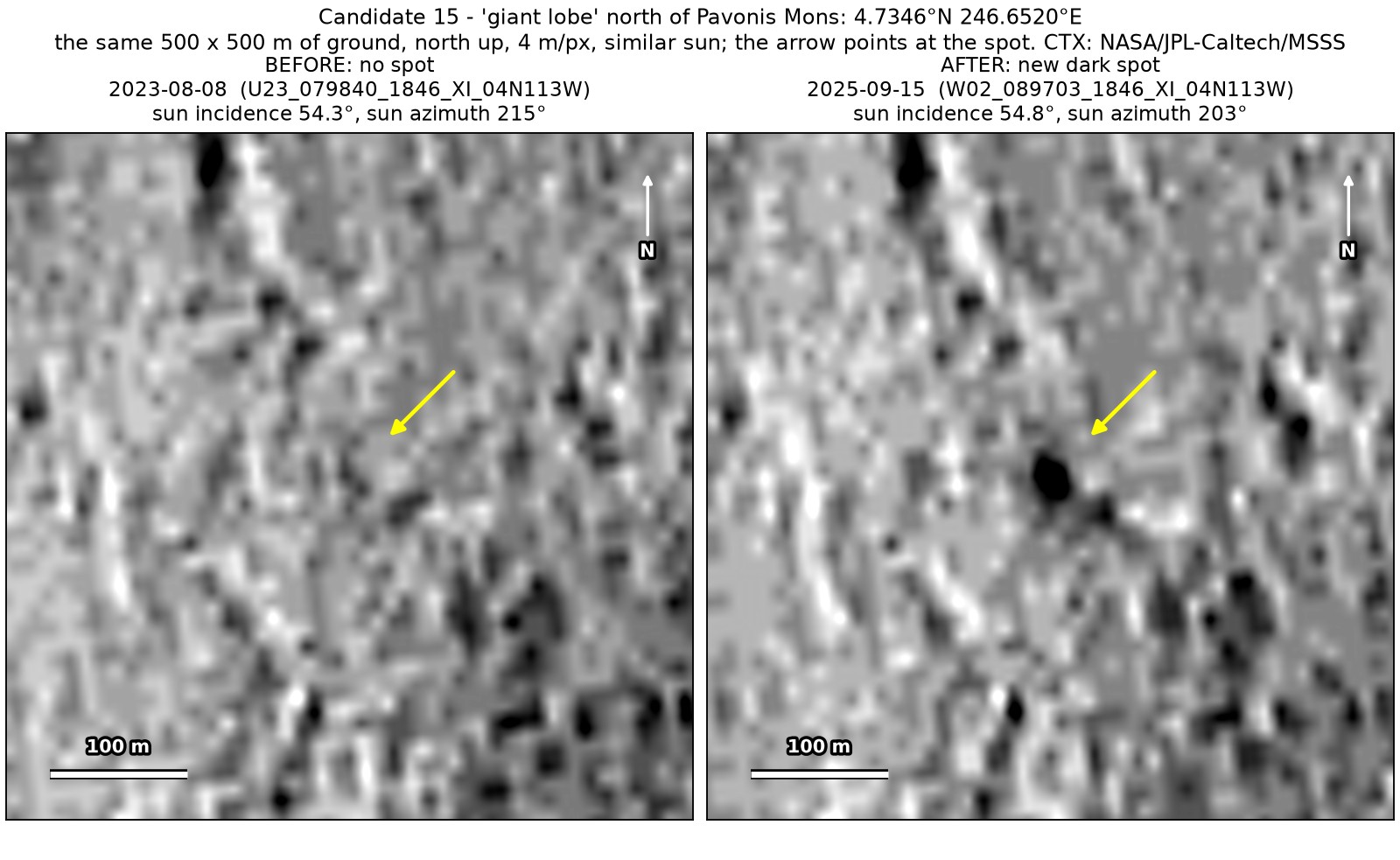
Two CTX close-ups of the same 500 by 500 m of lava north of Pavonis Mons, from August 2023 and September 2025, under a similar sun. A small dark spot at the arrow is present only in the 2025 image.
The same 500 × 500 m in August 2023 and September 2025, under a similar sun. The arrow marks the new spot. NASA/JPL-Caltech/MSSS.

What changed. A dark spot 25 to 30 m across appeared on a giant lava lobe north of the volcano Pavonis Mons between 26 September 2024 and 10 March 2025, a window of less than six months. It is in all four images taken since, fading slowly.

Why it may be a new impact. Nine earlier images, from 2014 to September 2024, show nothing there, and each of them would have shown a spot this dark. It keeps its place and shape under many different sun directions, so it is not a shadow, and it is seen on four separate orbits, so it is not a camera glitch. A compact, round spot on flat lava that fades slowly is what the blast zone of a small new crater looks like.

Location
4.735° N, 246.652° E (113.348° W)
Absent
nine images from 5 August 2014 to 26 September 2024
Present
10 March 2025, 10 May 2025, 15 September 2025 and 31 January 2026
Size
Dark spot 25 to 30 m across
Confidence
Strong candidate; roughly 90% that it is a new impact.
Caveat
It lies outside every footprint of the high-resolution HiRISE camera; one HiRISE image passed 0.5 km away in December 2022, before the spot formed. Like every candidate here, it is unconfirmed: see the caveat.
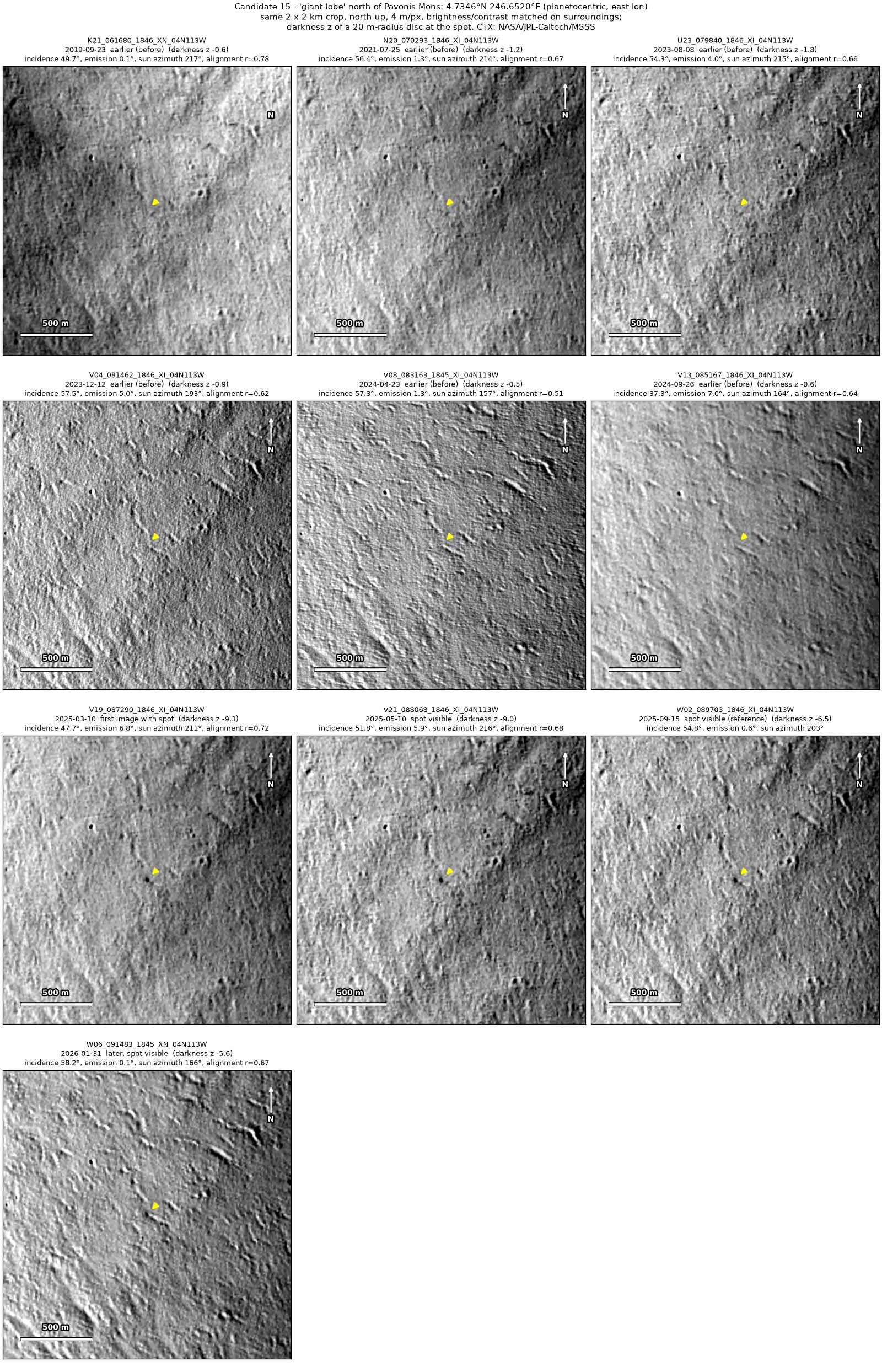
Ten CTX images of the same 2 by 2 km patch of lava, from 2019 to 2026. An arrow points to the spot, absent in the six images up to September 2024 and present in the four from March 2025 on.
Ten of the 34 CTX images of the spot, 2019 to 2026: the same 2 × 2 km patch at the same scale and contrast. The spot first appears in March 2025. NASA/JPL-Caltech/MSSS.
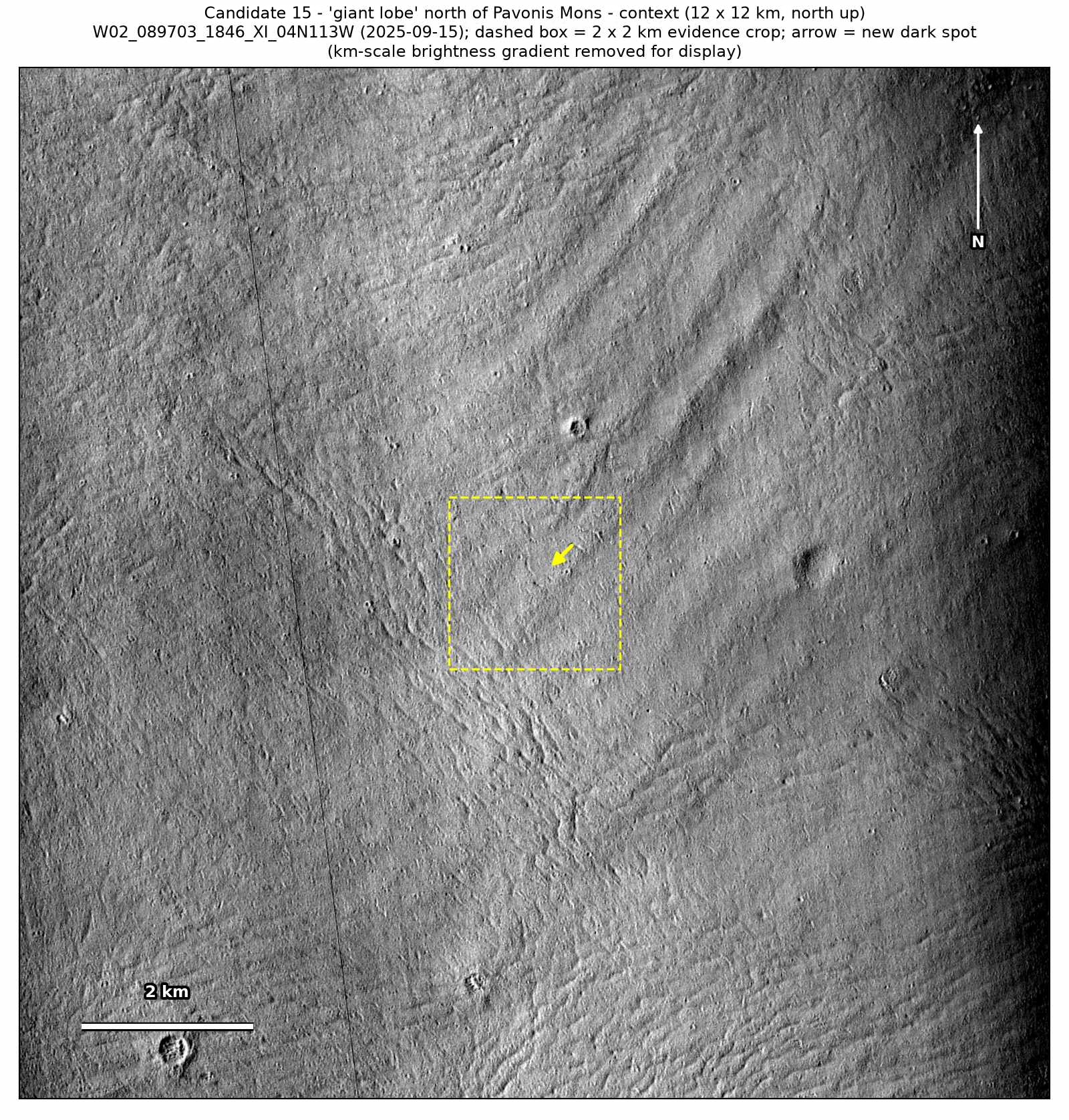
A 12 by 12 km CTX view from September 2025 of the lava lobe around the spot, with a dashed box around the 2 by 2 km patch and an arrow at the spot.
A 12 × 12 km view from September 2025. The dashed box is the 2 × 2 km patch. NASA/JPL-Caltech/MSSS.
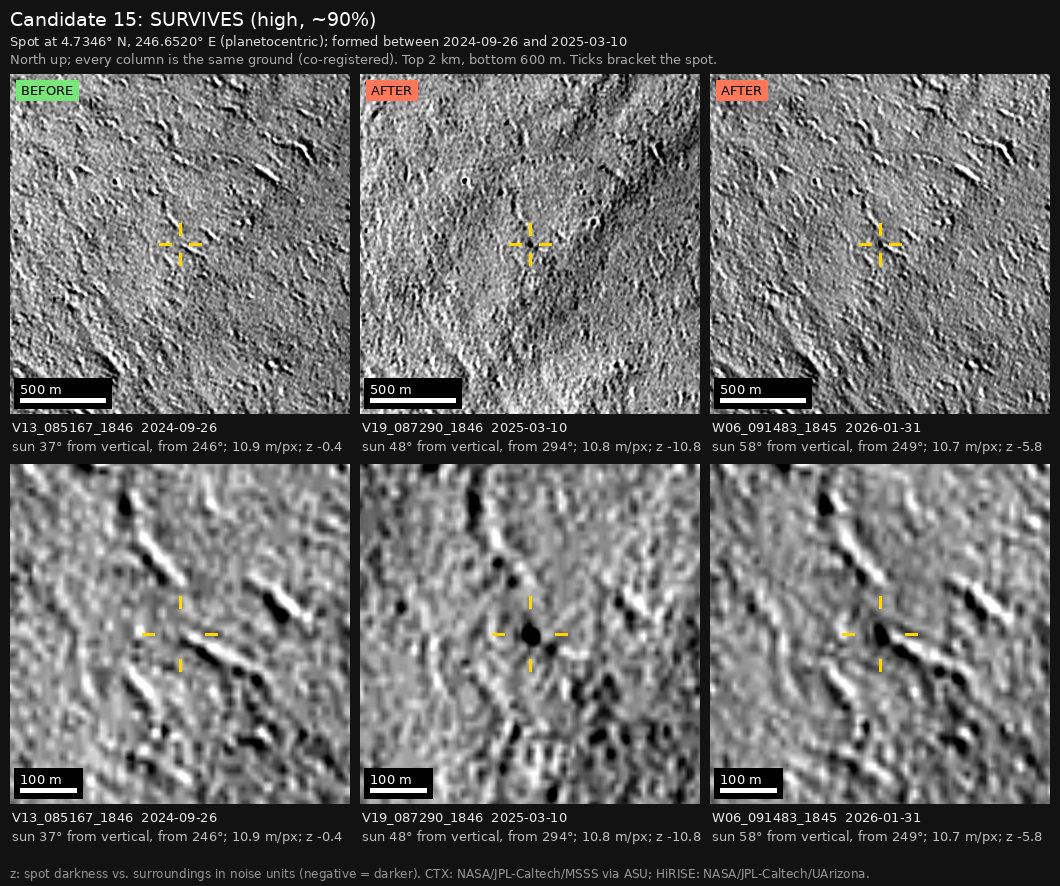
The independent check: three columns of the same ground, 2 km wide above and 600 m wide below, with yellow ticks around the spot. The spot is missing in the earlier image, marked BEFORE, and present in the two later images, marked AFTER.
Independent check. A second, deliberately sceptical review downloaded every image again and found that the candidate passes every test. Each column is the same ground, north up, 2 km wide above and 600 m wide below. Columns marked BEFORE are earlier images in which the spot would have been visible had it been there; those marked AFTER show it. Each image keeps one contrast stretch in both rows, so the close-up cannot create a spot. NASA/JPL-Caltech/MSSS.

· All candidates ·