Professor of Mathematics
Paata Ivanisvili
Department of Mathematics, University of California, Irvine

← Possible new impact sites on Mars
Candidate 1: Arsia Sulci, west of Arsia Mons
Strong · roughly 75%
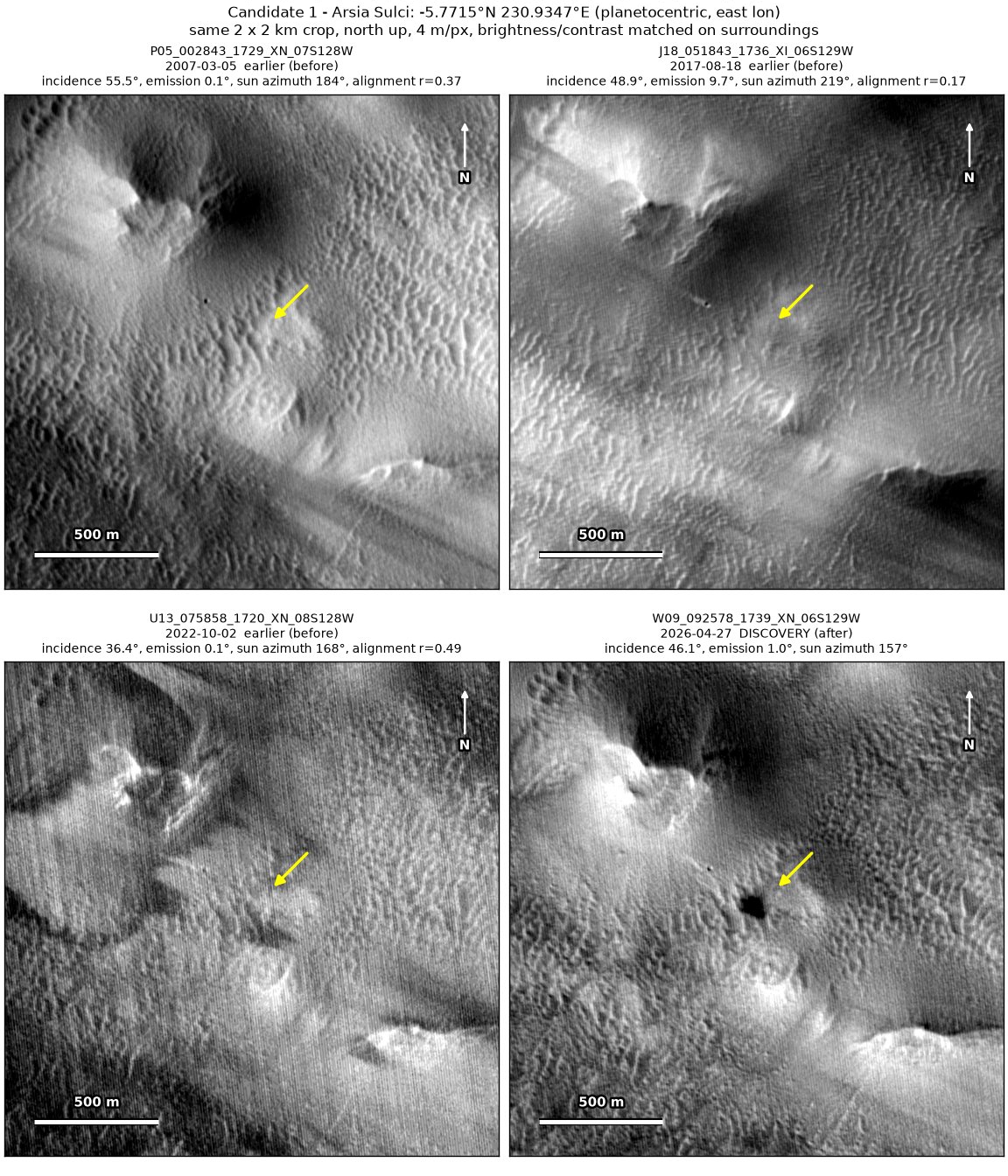
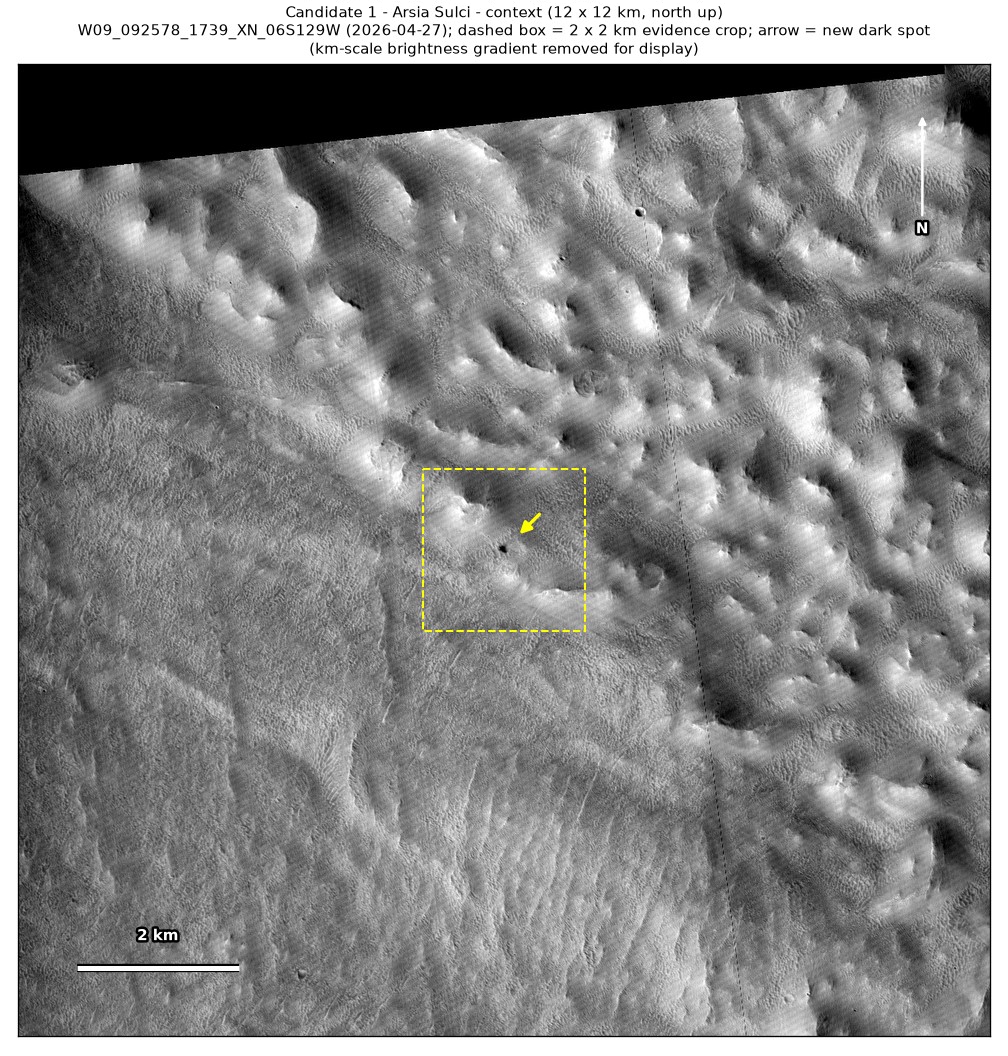
What changed. A round dark spot about 70 m across, inside a fainter halo about 150 m across, appears in the April 2026 image. The same ground shows nothing in four earlier images, taken with the Sun both higher and lower in the sky, so it is not a shadow.
Why it may be a new impact. Its compact shape and soft halo match the dark blast zones that fresh impacts leave on dusty ground. As a check, the same pair of images also re-found a known impact site 16 km to the south that the HiRISE team photographed in 2026.
- Location
- 5.772° S, 230.935° E (129.065° W)
- Absent
- 5 March 2007, 5 July 2016, 18 August 2017 and 2 October 2022
- Present
- 27 April 2026 (image W09_092578_1739)
- Size
- Dark spot about 70 m across, inside a fainter halo about 150 m across
- Confidence
- One of the strongest candidates. That the ground changed is very likely; that it is a new impact is likely, roughly 3 in 4.
- Caveat
- The weak point is that only one image shows it so far, because no newer CTX image has been released. It lies outside every footprint of the high-resolution HiRISE camera. Like every candidate here, it is unconfirmed: see the caveat.