Professor of Mathematics
Paata Ivanisvili
Department of Mathematics, University of California, Irvine

Candidate 48: a quiet old star that dimmed for a year and a half
Why this estimate. The dimming is real: ZTF flagged it 23 times and ASAS-SN, a separate network of small telescopes, saw the same dip while nearby stars stayed steady. But green and red light dimmed almost equally, which spots could also explain, the dip is shallow, the deepest part may have been missed while the Sun hid the star, and there is no spectrum.
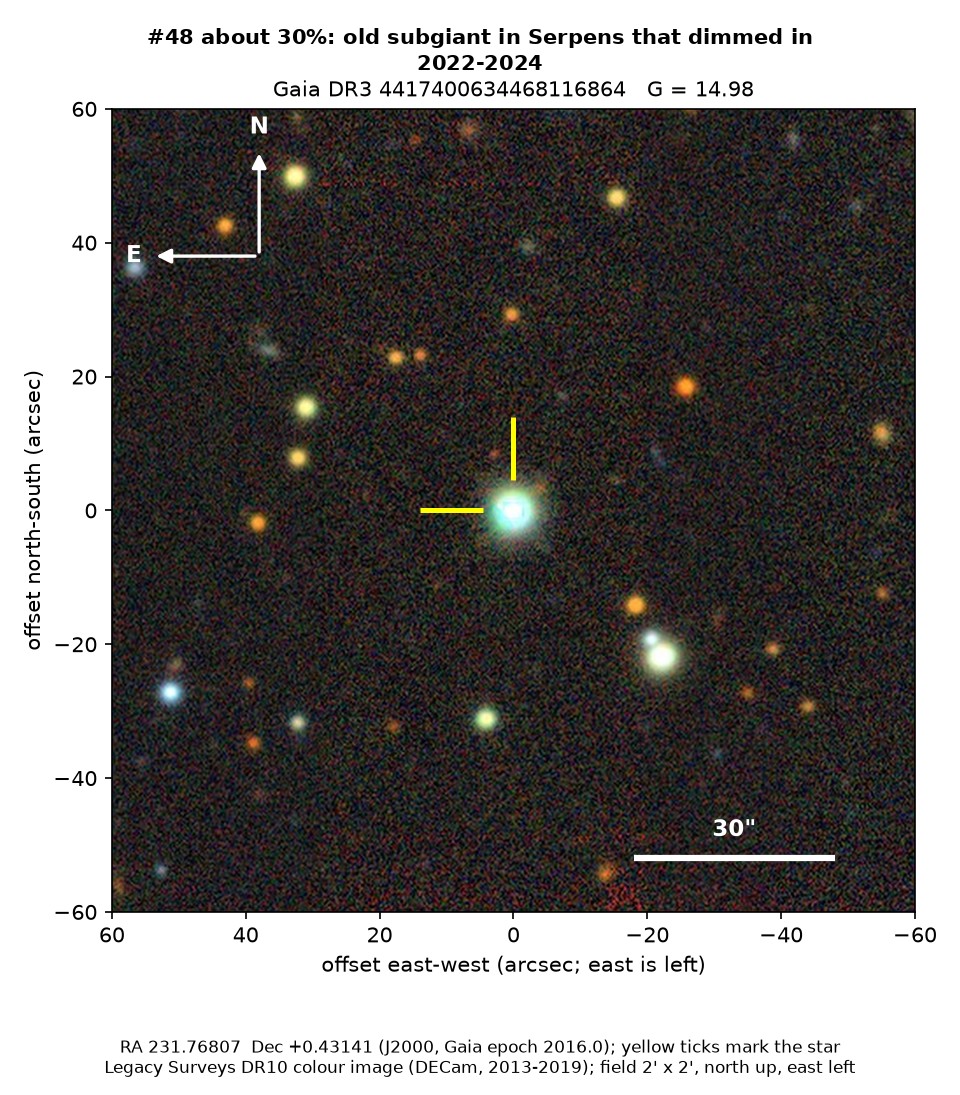
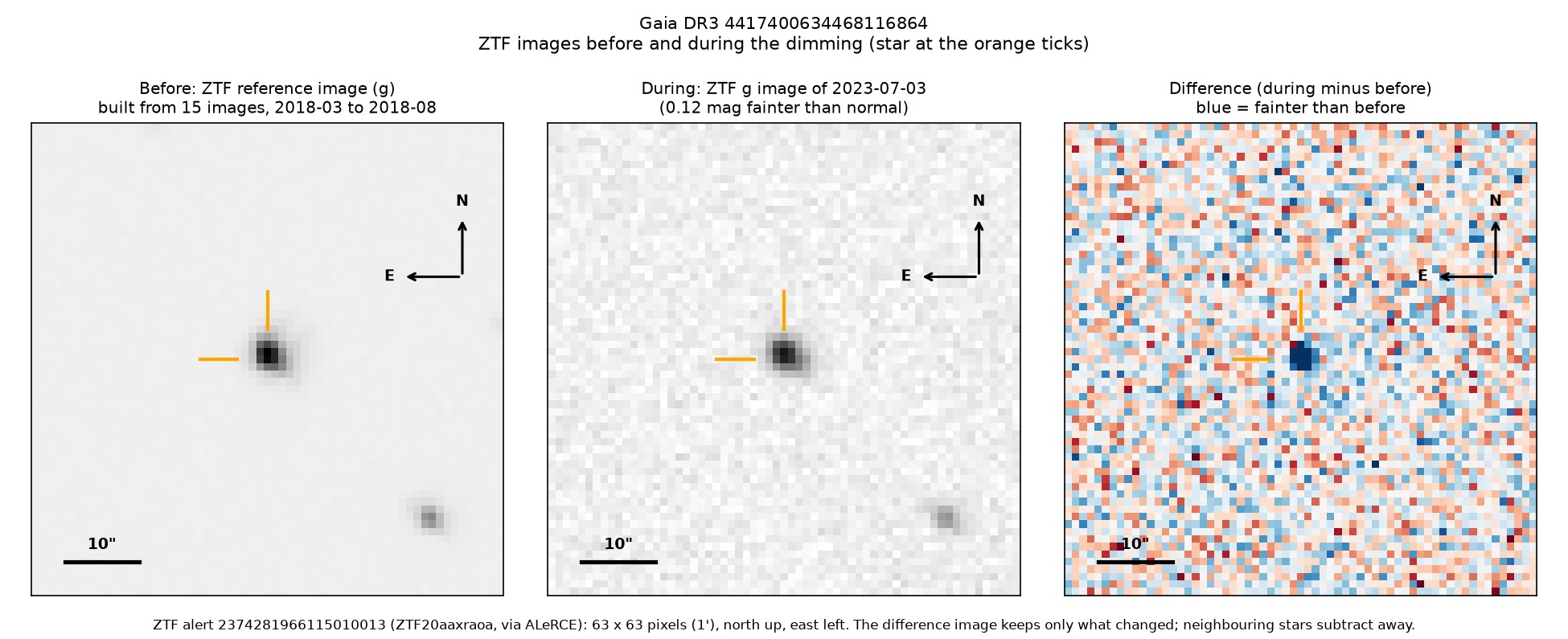
How to read the pictures. The finder chart shows a patch of sky two arcminutes across, about a fifteenth of the Moon’s width, with north up and east to the left. The star sits between the two yellow ticks, and the white bar is 30 arcseconds long. On a light curve the vertical axis is magnitude, a brightness scale on which larger numbers mean fainter stars, and it is drawn so that down means fainter. Purple shading marks the dimming. Each survey uses slightly different filters, so each is compared with its own normal level. The ZTF pictures show ZTF’s reference image of the star, an image taken during the dimming, and the difference between the two, in which only what changed remains: blue means fainter and red brighter.
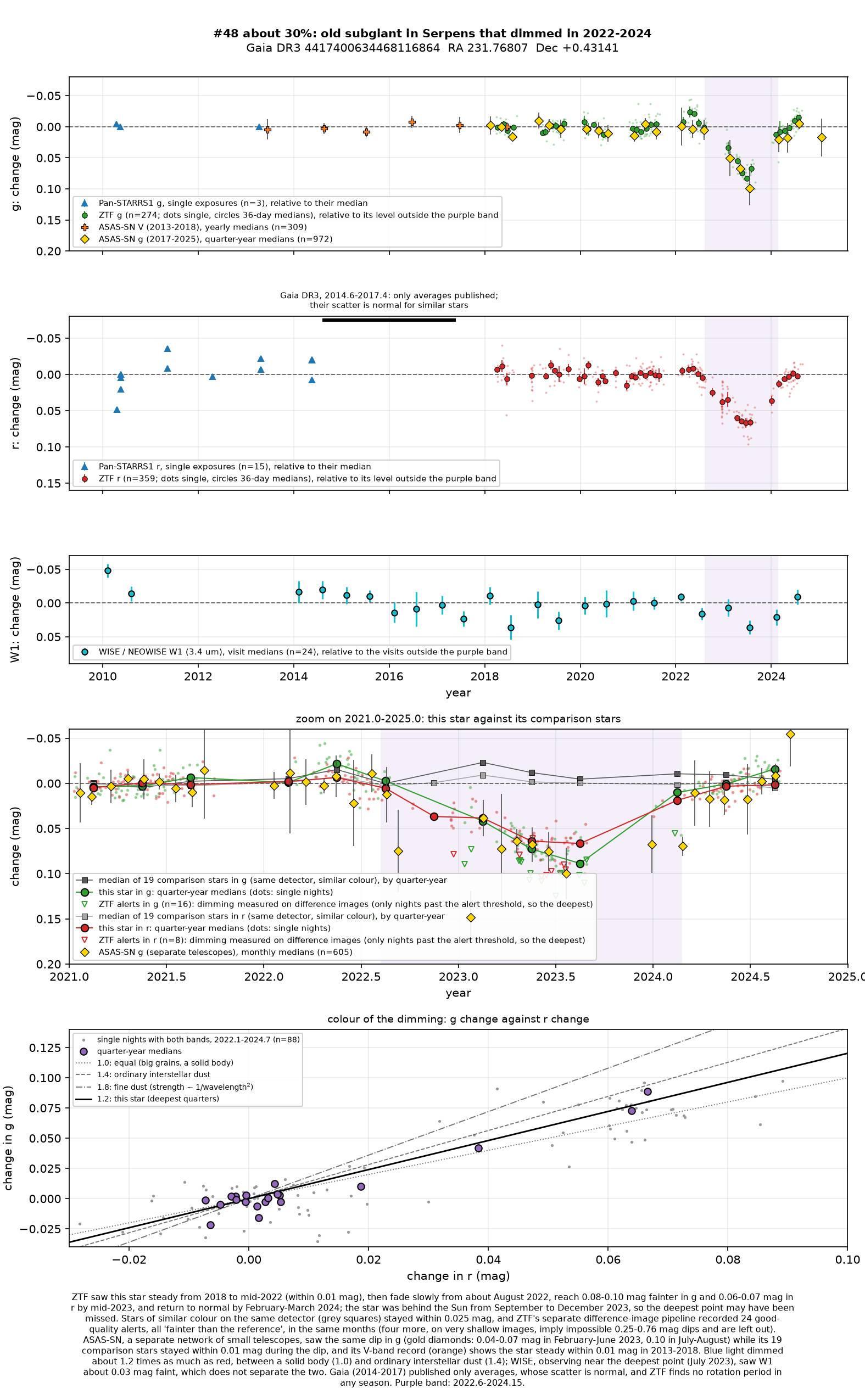
What changed. The star is a subgiant of about 5,250 K, somewhat poorer in heavy elements than the Sun and about 10 billion years old, 1,300 to 1,700 parsecs away and about a kiloparsec above the Milky Way’s plane, where almost all stars are old. ZTF saw it steady to within 0.01 magnitudes until mid-2022. From August 2022 it faded slowly, and from April to August 2023 it was 0.07 to 0.09 magnitudes fainter in green light and 0.06 to 0.07 in red, about 8 per cent less light. The Sun then hid it until December; in January and February 2024 it was only slightly faint, and from spring 2024 it was normal. ASAS-SN saw the same dip in green light.
Why it might matter. Old stars far from the plane should be quiet, and Gaia sees this one as a single, well-behaved star with no infrared excess and no sign of a companion, so a dust cloud passing in front of it would be unusual. Blue light dimmed only about 1.2 times as much as red light, between a solid body (1.0) and ordinary interstellar dust (1.4); WISE, near the deepest point, saw the star about 0.03 magnitudes faint at 3.4 microns, which cannot tell the two apart. GALEX saw the star faint in ultraviolet light, as a quiet star should be, and ZTF found no rotation period in any season.
No record of the dimming could be found. The star is not in SIMBAD, VSX (the variable-star index), Gaia’s variable-star lists or the other catalogues consulted, nor among the dimming stars of Tzanidakis et al. (2025), and there is no Transient Name Server entry, Gaia alert or paper giving its Gaia number. ZTF’s alert system holds only machine-generated classifications for it.
- Star
- Gaia DR3 4417400634468116864, an old subgiant
- Location
- RA 231.76807°, Dec +0.43141° (J2000), in Serpens, 44 degrees above the Milky Way’s mid-plane
- Distance
- 1,300 to 1,700 parsecs (4,200 to 5,500 light-years)
- Brightness
- Gaia G = 15.0, far too faint for the eye
- Probability
- This candidate is unconfirmed. The percentage under the title is an estimate of the chance that it is a real, previously unrecorded case of the kind described. The estimate has not been checked by outside experts. See the introduction to all fifty-eight candidates.
- Caveat
- Only one ZTF field covers the star, and only ZTF measured the colour. The dip is shallow, its deepest part may have fallen in a gap, and its colour is within the range of starspots. There is no spectrum, and the two distance estimates disagree.