Professor of Mathematics
Paata Ivanisvili
Department of Mathematics, University of California, Irvine

Candidate 3: an orange dwarf in Aquila that has been fading for a decade
Why this estimate. The fading is certainly real: Gaia, the Dark Energy Camera, ZTF and WISE all recorded it, and field stars of the same colour did not fade. But the steady level before it is known only for 2009 to 2013, the fading paused and partly reversed in 2019 to 2021, and there is no spectrum. The estimate is also modest because similar spotted dwarfs, including two with no measured rotation, drift by about as much, so the star’s quietness is a weaker argument for dust than it might seem.
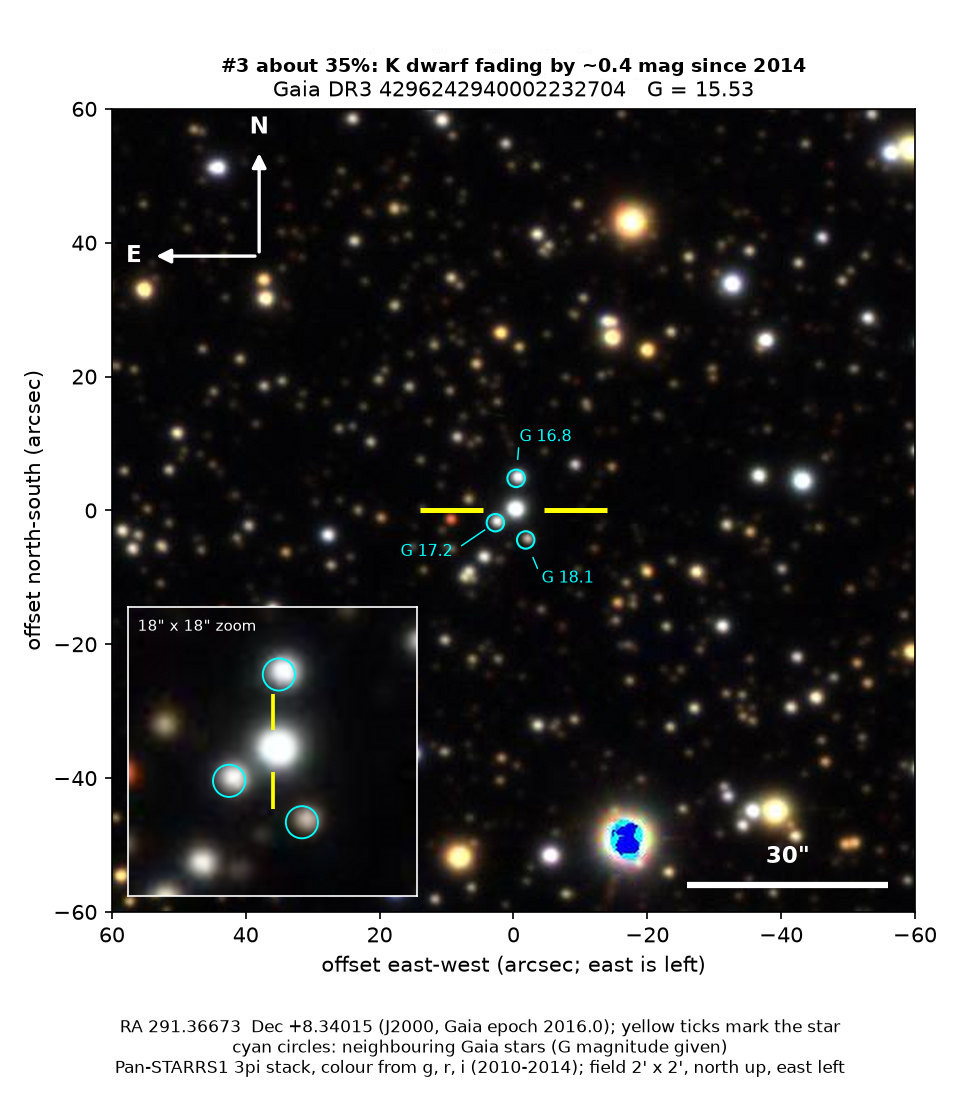
How to read the pictures. The finder chart shows a patch of sky two arcminutes across, about a fifteenth of the Moon’s width, with north up and east to the left. The star sits between the two yellow ticks, and the white bar is 30 arcseconds long. On a light curve the vertical axis is magnitude, a brightness scale on which larger numbers mean fainter stars, and it is drawn so that down means fainter. On this light curve, purple shading marks the fading. Each survey uses slightly different filters, so each is compared with its own normal level.
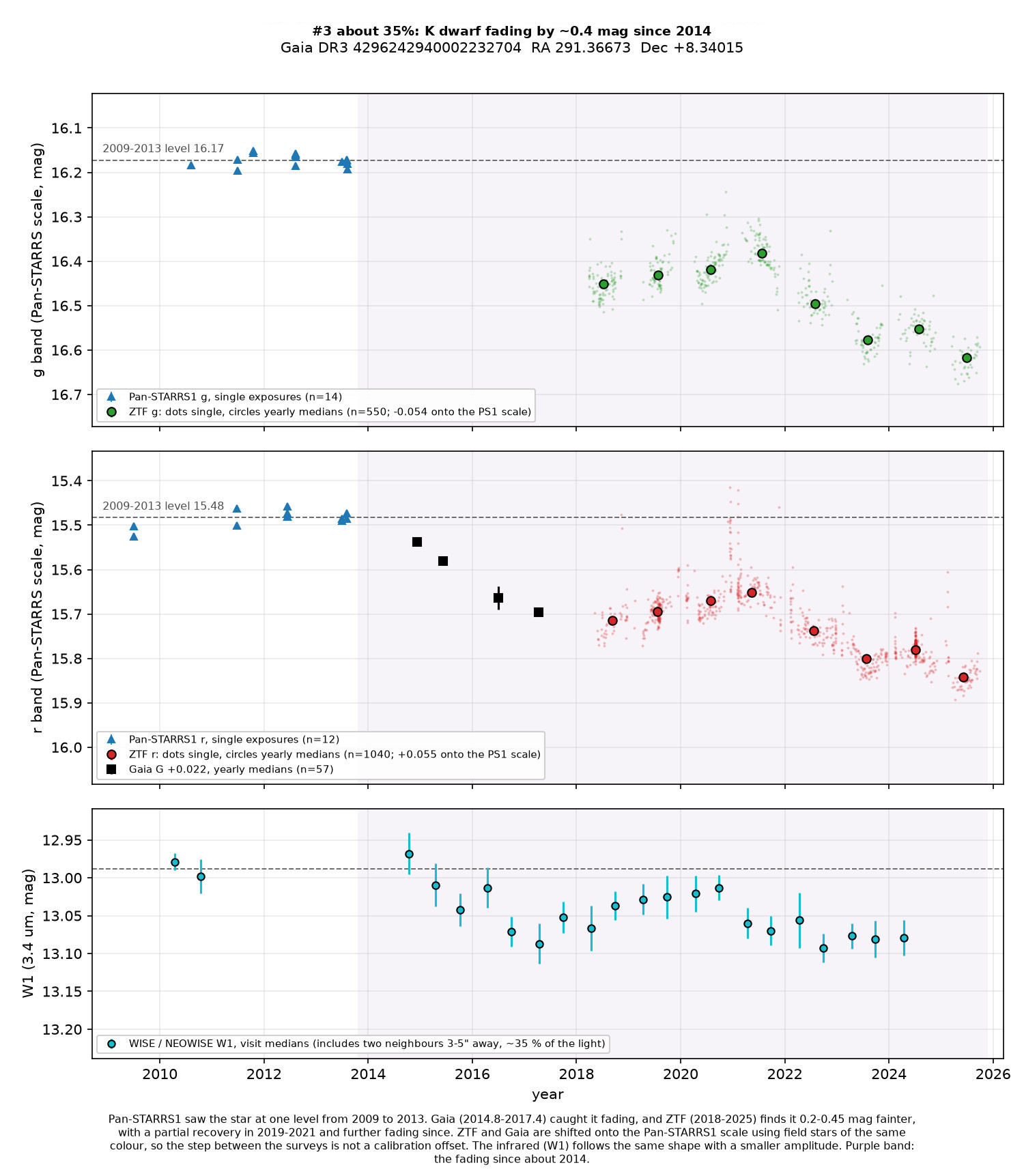
What changed. The star is an orange dwarf in Aquila, a little cooler and smaller than the Sun, about 790 parsecs (2,600 light-years) away. Its brightness for its distance places it on the main sequence: it is an ordinary hydrogen-burning star, neither young nor a giant. Pan-STARRS1 saw it at one steady level from mid-2009 to mid-2013, in 26 exposures in green and red light, all within 0.05 magnitudes of the average. Then it began to fade. The Dark Energy Camera caught the start: in mid-2014 the star was 0.07 magnitudes fainter in red light than in early 2013. From late 2014 to mid-2017 Gaia saw a steady fade of 0.07 magnitudes a year, slightly faster in blue light than in red. From 2018 to 2025 ZTF finds the star 0.2 to 0.45 magnitudes below the Pan-STARRS1 level. It recovered a little, by about 0.07 magnitudes, in 2019 to 2021, then faded further, and it was still fading in 2025. In the infrared, at 3.4 microns, the same pattern appears with a smaller amplitude. Compared with ten nearby stars of similar brightness and colour, the star is now about 0.4 magnitudes fainter in green light and 0.33 magnitudes fainter in red than it was in 2009 to 2013: about 25 to 30 per cent less light.
Why it might matter. This star is the mirror image of candidate 5. Ordinary quiet dwarf stars do not fade by a third of their light over a decade. Magnetic activity cycles change such stars by a few hundredths of a magnitude, up to about 0.1, and the changes repeat. This star is quiet from night to night: ZTF’s scatter is no larger than its measurement errors, the strongest periodic signal (1.38 days) is only 0.005 magnitudes, and when the data are analysed season by season, no period repeats more often than it does in nearby stars. Its Gaia spectrum shows no hydrogen-alpha emission. That leaves two explanations. One is dust moving into the line of sight. The infrared faded about 0.45 times as much as the red light, whereas ordinary interstellar dust would dim the infrared much less, so the grains would have to be large. The other is a change in the star itself. The colours also fit a cooler surface or more dark spots, but the surface would have to cool by about 300 K, or spots would have to spread over a large part of a star that shows neither hydrogen emission nor a rotational wobble. Passing dust is the simpler reading, although nothing shows the dust directly.
SIMBAD lists nothing known about the star. The variable-star index lists it only because it copies Gaia’s machine classification, and Gaia alerts, published variable-star lists and arXiv show nothing. Gaia’s fit to the star’s motion is that of a normal single star, and its images show no second peak. The three neighbours marked on the finder chart, 3 to 5 arcseconds away, are much more distant background stars, and Gaia sees them as steady. The fading is the same in two separate ZTF fields. Ninety-five per cent of the comparison stars changed by less than 0.08 magnitudes between Pan-STARRS1 and ZTF, and within ZTF the star’s change since 2018 is larger than that of any of the 15 comparison stars.
- Star
- Gaia DR3 4296242940002232704, an orange K dwarf
- Location
- RA 291.36673°, Dec +8.34015° (J2000), in Aquila, 3.7 degrees below the plane of the Milky Way
- Distance
- about 790 parsecs (2,600 light-years), uncertain by about 2 per cent
- Brightness
- Gaia G = 15.53
- Probability
- This candidate is unconfirmed. The percentage under the title is an estimate of the chance that it is a real, previously unrecorded case of the kind described. The estimate has not been checked by outside experts. See the introduction to all fifty-eight candidates.
- Caveat
- No spectrum of the star exists in the archives that were checked. The steady level is known only for 2009 to 2013; older photographic plates were not examined. The partial recovery in 2019 to 2021 makes the shape less clean than that of candidate 5. The field is crowded: in WISE the neighbours make up about a third of the light, which has been allowed for. Gaia’s classifier calls the star a spotted active star, a label probably driven by the slow trend itself. Among 425 similar dwarfs, ten changed by 0.45 magnitudes or more, and two of the three that, like this star, do not spin fast still changed. So the lack of rotation sets it apart less than it might seem.