Professor of Mathematics
Paata Ivanisvili
Department of Mathematics, University of California, Irvine

Candidate 17: an F star on a long, elongated orbit
Why this estimate. The orbit takes longer than Gaia’s published observations lasted, so its period, shape and size are poorly constrained. A star 30 per cent lighter than modelled would bring the companion below 1.4 solar masses, a close pair of ordinary stars could mimic it, and no measurements along the line of sight confirm it.
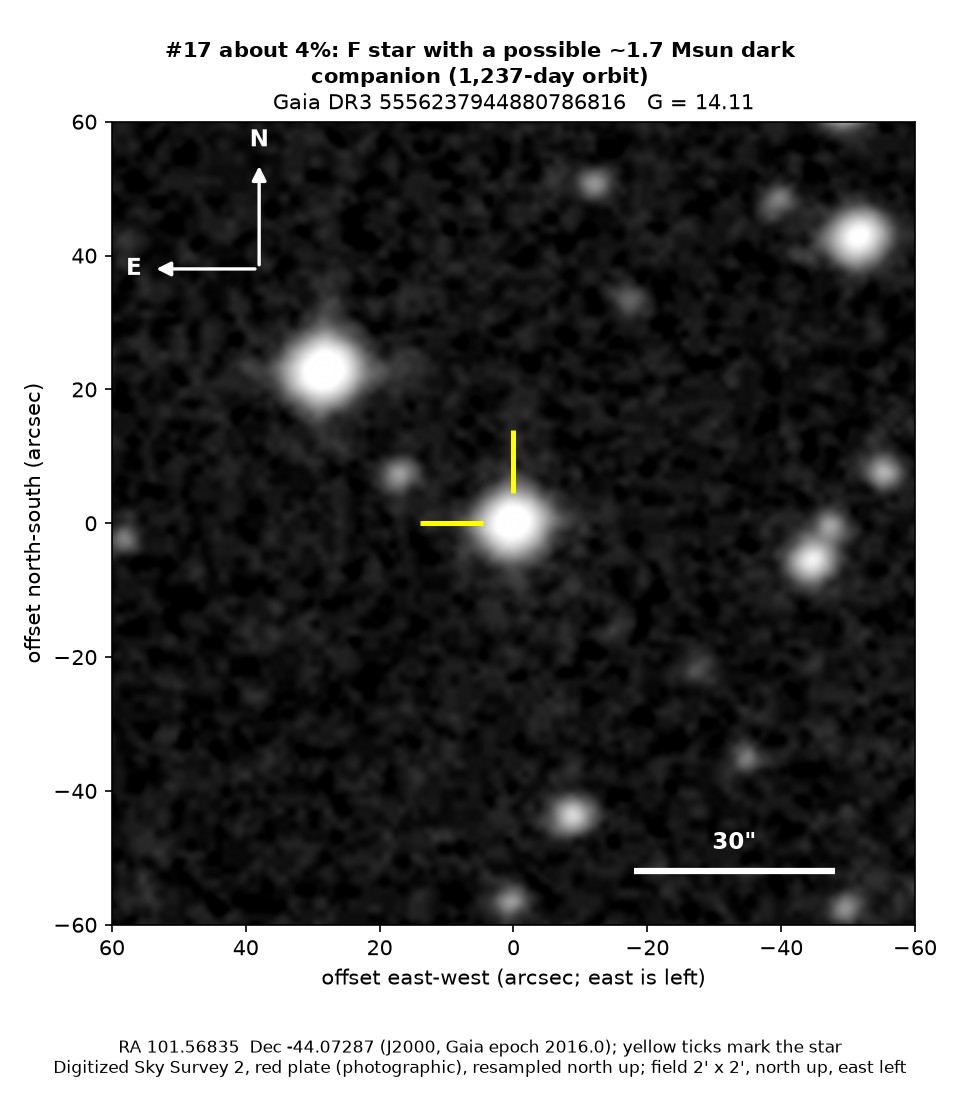
How to read the pictures. The orbit figure has three panels. On the left is the small ellipse that Gaia’s orbit traces on the sky, measured in thousandths of an arcsecond, with grey orbits that fit the data about equally well. In the middle is the mass the unseen companion would need for each possible mass of the visible star; the shaded band is the likely range, the red line marks the star’s estimated mass, and the dotted and dashed lines mark 3 and 1.4 solar masses, roughly where black holes begin and where a typical neutron star lies. On the right, the star (red) sits among other stars in Gaia’s diagram of colour against brightness. The finder chart shows a patch of sky two arcminutes across, about a fifteenth of the Moon’s width, with north up and east to the left; the star sits between the two yellow ticks, and the white bar is 30 arcseconds long.
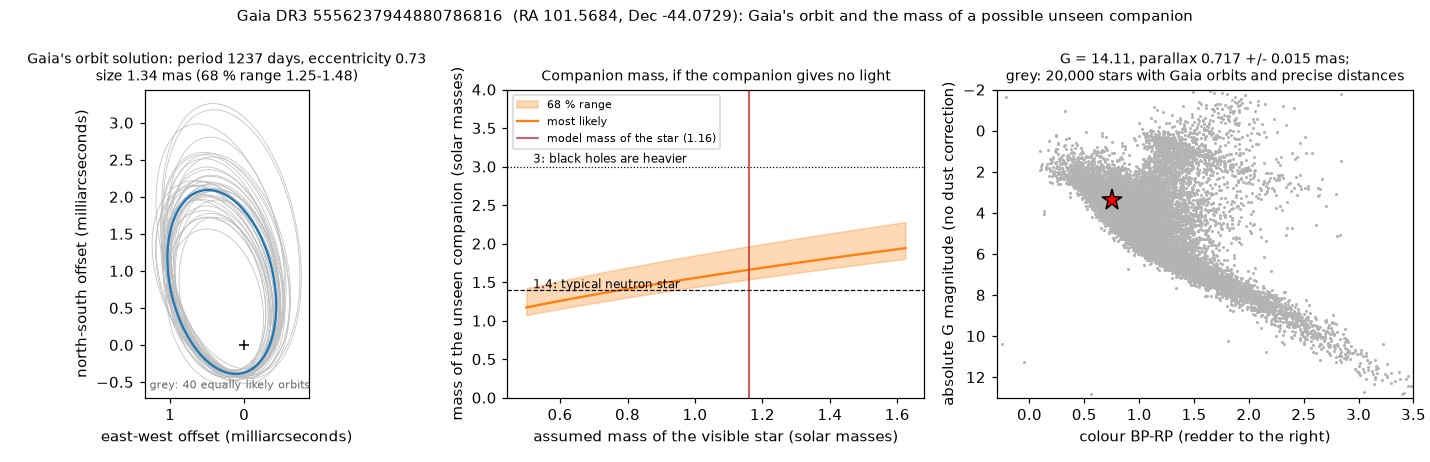
What Gaia found. This is a yellow-white star of type F, about 6,300 K, some 1,400 parsecs away in Puppis. Gaia’s main orbit-fitting method found a very elongated orbit (eccentricity 0.73) with a period of 1,237 days. If the star has about 1.2 solar masses, the companion has about 1.7 solar masses (1.5 to 2.0) and gives off no visible light: it could be a neutron star or a heavy white dwarf.
Why the estimate is low. The period is longer than the 1,038 days of Gaia’s third data release, so the orbit is poorly constrained. If the star is 30 per cent lighter than its model mass, the companion drops below 1.4 solar masses. A close pair of ordinary stars, together orbiting the visible star, can mimic a dark companion of this mass, and there are no measurements of the star’s speed along the line of sight.
No record of a dark companion for this star could be found. The star is too far south for Pan-STARRS1 and ZTF, so there is no light curve.
- Star
- Gaia DR3 5556237944880786816, an F-type star
- Location
- RA 101.56835°, Dec −44.07287° (J2000), in Puppis
- Distance
- about 1,400 parsecs (4,600 light-years)
- Brightness
- Gaia G = 14.1
- Probability
- This candidate is unconfirmed. The percentage under the title is an estimate of the chance that it is a real, previously unrecorded case of the kind described. The estimate has not been checked by outside experts. See the introduction to all fifty-eight candidates.
- Caveat
- The orbit is longer than Gaia’s observations, the companion’s mass depends on the star’s uncertain mass, a triple system would look the same, and no measurements along the line of sight confirm the orbit.