Professor of Mathematics
Paata Ivanisvili
Department of Mathematics, University of California, Irvine

Candidate 13: a wobble that hints at a dark companion
Why this estimate. The orbit is one of Gaia’s less reliable solutions: it fails the published filter on parallax quality, no measurements along the line of sight confirm it, and orbits of this kind are often spurious.
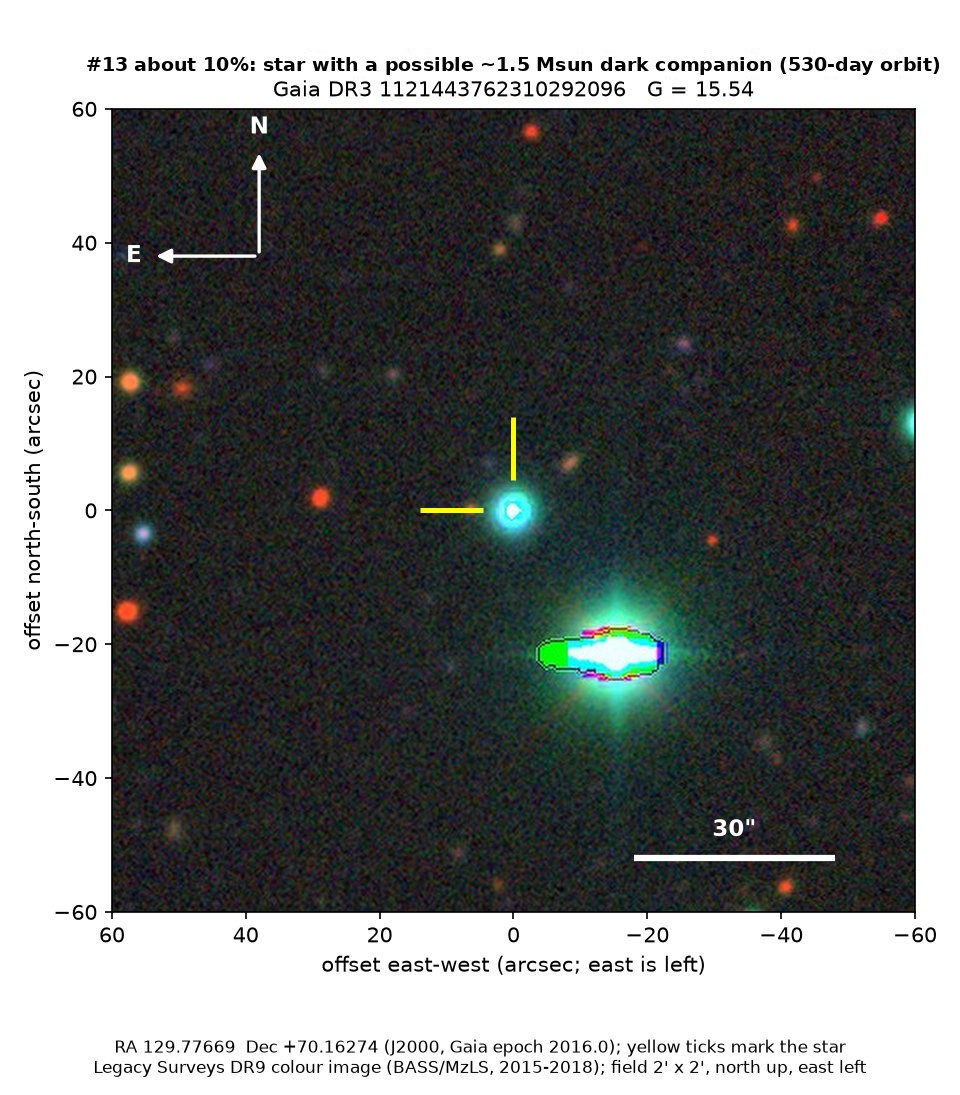
How to read the pictures. The finder chart shows a patch of sky two arcminutes across, about a fifteenth of the Moon’s width, with north up and east to the left. The star sits between the two yellow ticks, and the white bar is 30 arcseconds long. On a light curve the vertical axis is magnitude, a brightness scale on which larger numbers mean fainter stars, and it is drawn so that down means fainter. Here the orange band marks the years in which Gaia measured the orbit, not a change in brightness. Each survey uses slightly different filters, so each is compared with its own normal level.
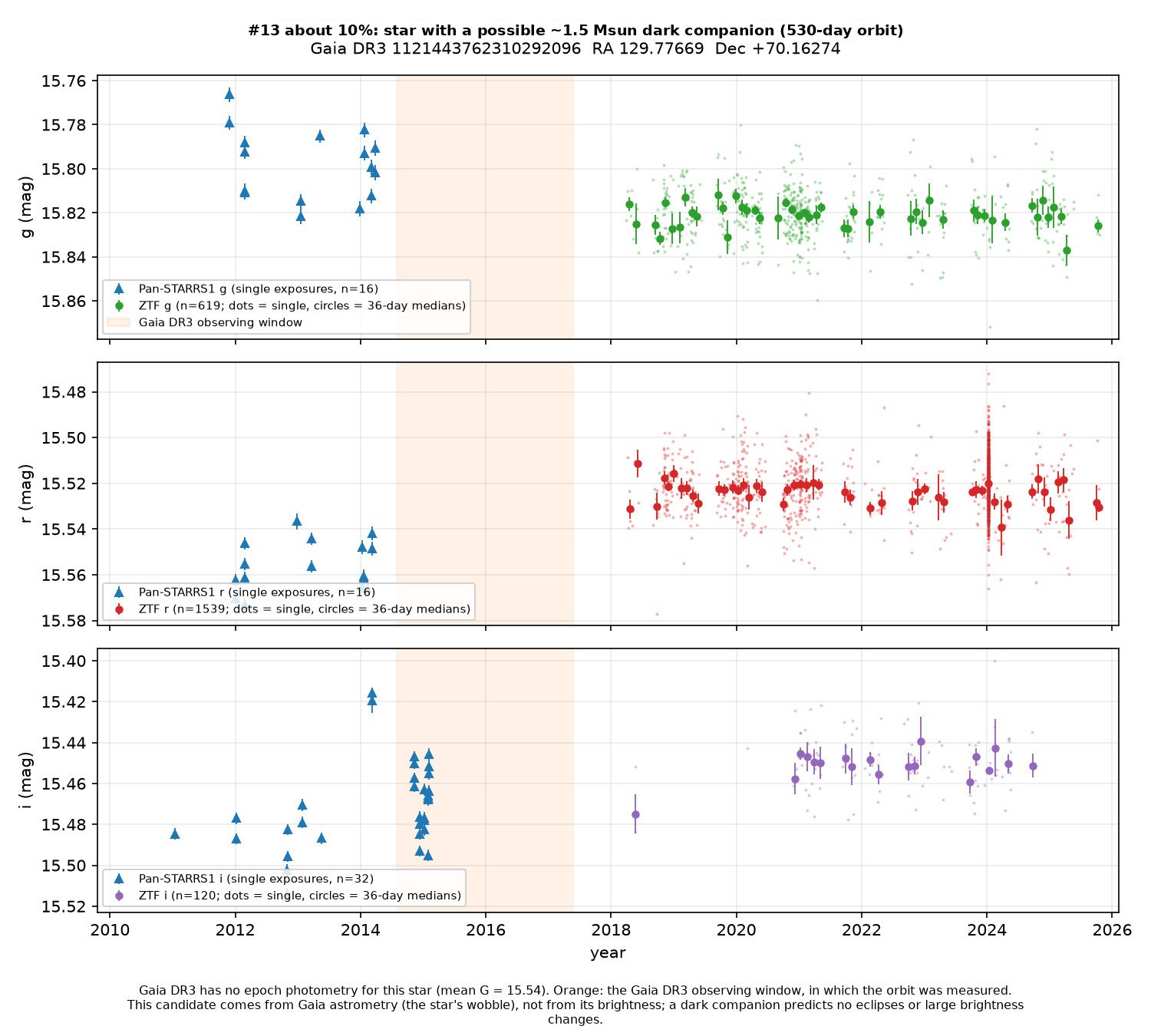
What Gaia found. This is a Sun-like star in Ursa Major that moves in a small ellipse on the sky every 530 days, as if a companion were pulling it around. If the star has about 0.8 solar masses, the companion would have 1.35 to 1.72 solar masses and yet give off no light that Gaia can see. It could be a neutron star, a heavy white dwarf or a pair of white dwarfs. The steady light curve is consistent with a dark companion, since the brightness does not have to change for the wobble to be real.
Why the estimate is low. The orbit fails one of Gaia’s recommended quality cuts: the parallax signal-to-noise ratio, the parallax divided by its uncertainty, is 23.7, and the cut requires 37.7. A mass near 1.5 times the Sun’s cannot tell a neutron star from a heavy white dwarf, and there are no measurements of the star’s speed along the line of sight to confirm the orbit.
- Star
- Gaia DR3 1121443762310292096, a Sun-like star
- Location
- RA 129.77669°, Dec +70.16274° (J2000), in Ursa Major
- Distance
- about 1,500 parsecs (5,000 light-years)
- Brightness
- Gaia G = 15.5
- Probability
- This candidate is unconfirmed. The percentage under the title is an estimate of the chance that it is a real, previously unrecorded case of the kind described. The estimate has not been checked by outside experts. See the introduction to all fifty-eight candidates.
- Caveat
- The orbit does not pass Gaia’s quality cut on the parallax, the mass does not say what the companion is, and no measurements along the line of sight confirm the orbit.