Professor of Mathematics
Paata Ivanisvili
Department of Mathematics, University of California, Irvine

Candidate 10: a star that brightened by 70% for a few months
Why this estimate. SkyMapper and NEOWISE independently recorded a brightening that was the same from visible light out to 4.6 microns, as lensing predicts. However, OGLE’s survey of the Galactic disc covered this field without listing an event, and the lens parameters are not pinned down.
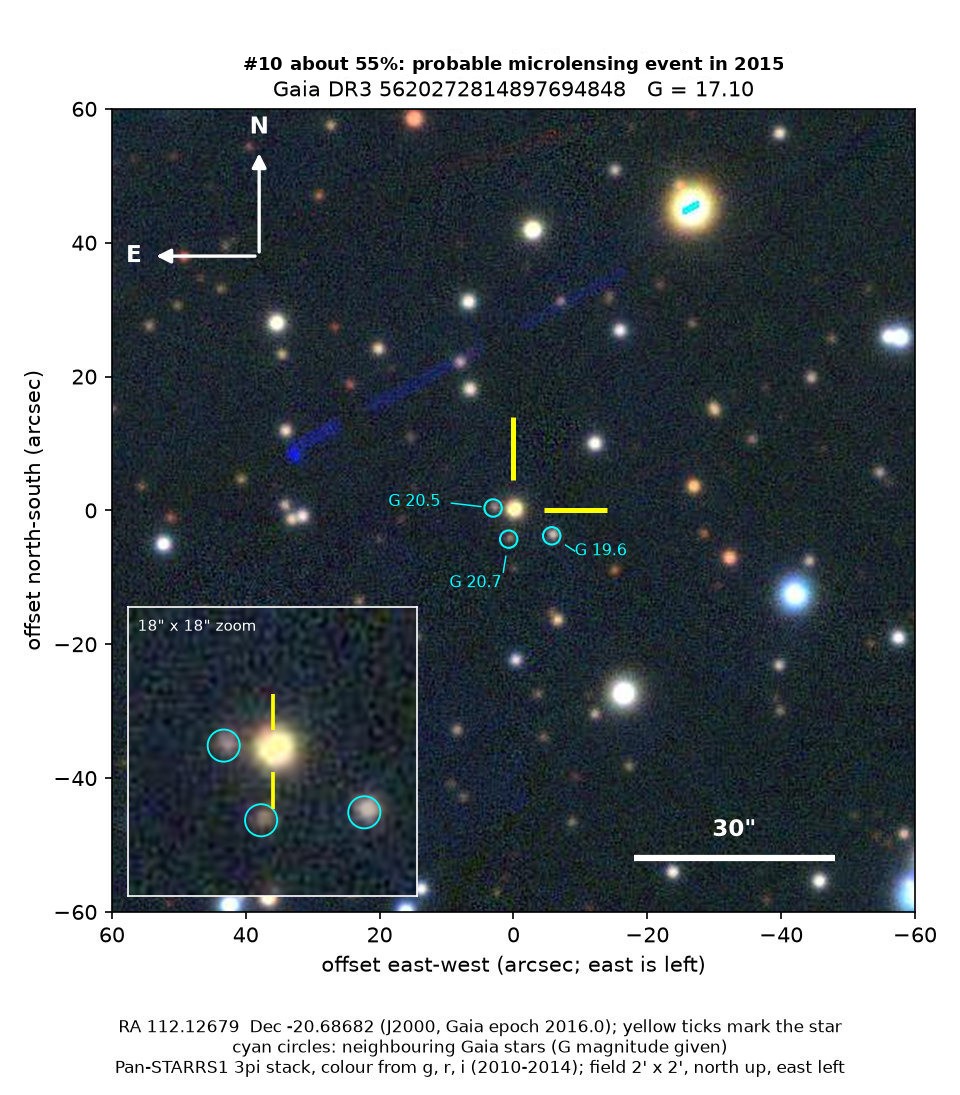
How to read the pictures. The finder chart shows a patch of sky two arcminutes across, about a fifteenth of the Moon’s width, with north up and east to the left. The star sits between the two yellow ticks, and the white bar is 30 arcseconds long. On a light curve the vertical axis is magnitude, a brightness scale on which larger numbers mean fainter stars, and it is drawn so that down means fainter. Orange shading marks the change. Each survey uses slightly different filters, so each is compared with its own normal level.
Dates such as 2016.22 are written as a year plus a fraction of a year: 2016.00 is the start of 2016, and 2016.50 is about halfway through it.
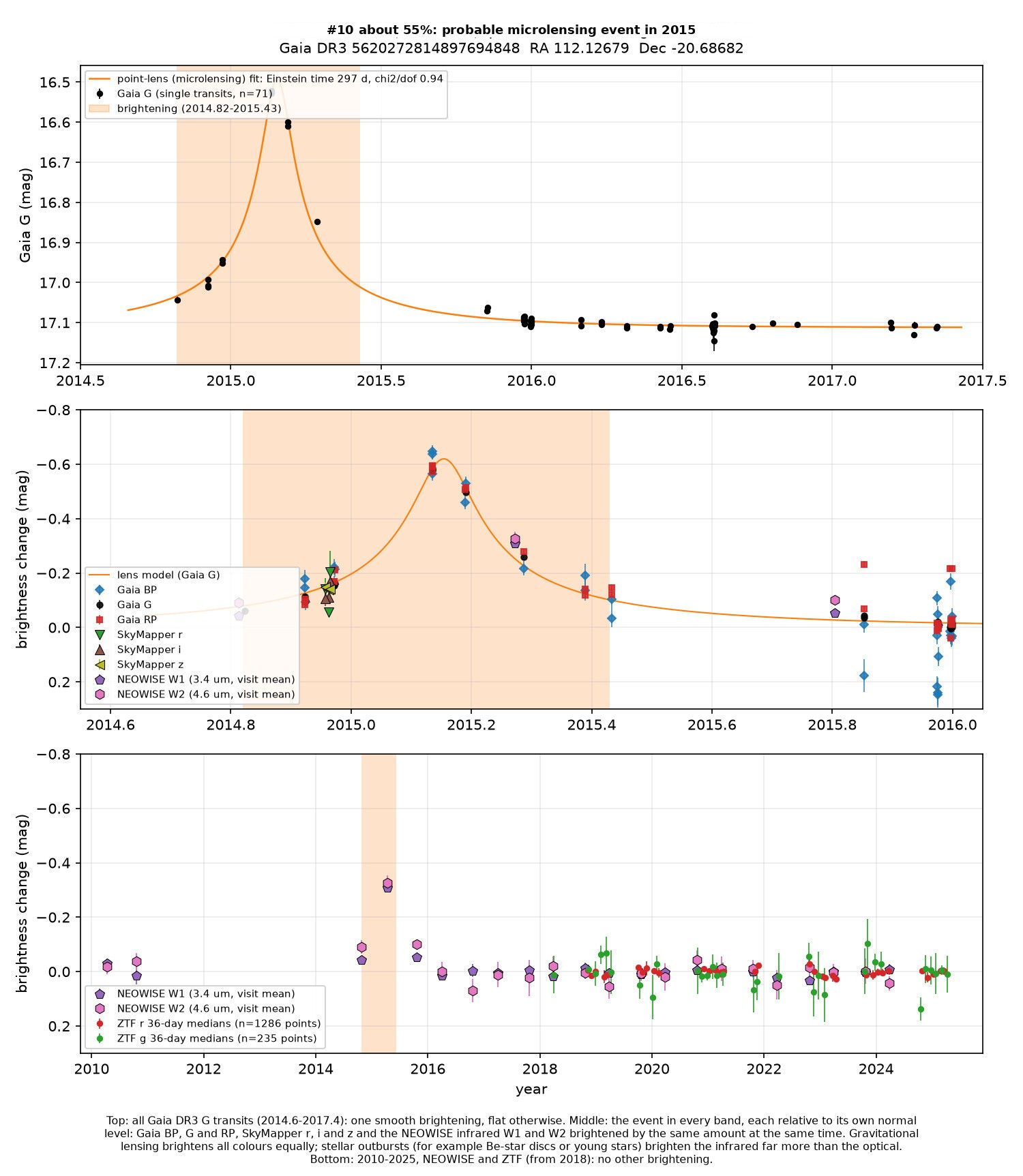
What changed. This is a distant star in Puppis, 1.5 degrees below the mid-plane of the Milky Way and roughly opposite the Galactic centre. Its parallax, Gaia’s measure of distance, is 0.14 ± 0.06 milliarcseconds, which puts it several thousand parsecs away, behind a lot of dust. Gaia’s fit to its colours suggests a hot star, about 8,100 K. Gaia measured it 71 times between 2014 and 2017, and it was steady except at the start: it rose from late 2014, peaked around 2015.15 at 0.6 magnitudes brighter than normal (1.7 times the light), was nearly back to normal by mid-2015 and was fully back by late 2015.
Two other telescopes caught the same event. SkyMapper, in Australia, saw it on three nights around 2014.97, when the star was 0.06 to 0.20 magnitudes brighter, typically 0.14, in its r, i and z filters, and Gaia had it 0.16 magnitudes brighter. NEOWISE, an infrared satellite, saw it at 2015.27, when the star was 0.31 magnitudes brighter at 3.4 microns and 0.33 magnitudes brighter at 4.6 microns, and Gaia had it about 0.30 magnitudes brighter. WISE and NEOWISE observed the star in 2010 and twice a year from 2014 to 2024, and ZTF observed it from 2018 to 2025; neither saw anything else.
Why it might matter. A foreground star passing almost exactly in front of a distant star focuses its light, so the distant star brightens and fades once, smoothly, and by the same factor at every wavelength. Here the brightening was the same in Gaia’s blue, green and red bands and in the infrared out to 4.6 microns. The standard lensing model fits the Gaia light curve better than a plain bump does, and the brightening happened only once in 15 years. Gaia’s classifier labelled it as microlensing.
The event may be new. It is not in Gaia’s published list of 363 microlensing events, it has no Gaia alert, and it has no entry in SIMBAD, VSX (the variable-star index) or the Transient Name Server. Nothing about it appears on arXiv either. It is not in the bulge event lists of OGLE or KMTNet, nor in OGLE’s published list of microlensing events in the Galactic disc (Mroz et al. 2020). Events towards this side of the Galaxy are rare, which is what would make this one valuable. Microlensing is an expected kind of event, not an exotic one.
- Star
- Gaia DR3 5620272814897694848; Gaia’s fit to its colours suggests a hot star, about 8,100 K
- Location
- RA 112.12679°, Dec −20.68682° (J2000), in Puppis
- Distance
- parallax 0.14 ± 0.06 milliarcseconds, so several thousand parsecs away, behind a lot of dust
- Brightness
- Gaia G = 17.1
- Probability
- This candidate is unconfirmed. The percentage under the title is an estimate of the chance that it is a real, previously unrecorded case of the kind described. The estimate has not been checked by outside experts. See the introduction to all fifty-eight candidates.
- Caveat
- The star lies inside an OGLE Galactic-disc field, GD1639, which was imaged 171 times from 2013 to 2019, yet OGLE did not list an event here. OGLE’s selection cuts may have dropped it, or OGLE’s own data may disagree; its measurements of this star are not available to check. The lensing model is poorly pinned down: it prefers a long timescale, about 300 days, with the lensed star providing only a small part of the light, a combination that is notoriously uncertain. Gaia’s colour points scatter more than their stated errors. Hot stars with gas discs, called Be stars, also brighten for months, but their outbursts brighten the infrared much more than visible light, which is not what NEOWISE saw. Three faint stars, with Gaia G from 19.6 to 20.7, lie 3 to 7 arcseconds away, but they are too faint to cause a 70 per cent brightening.